

COVID-19
UNIC Coronavirus Health and Research Portal
On Respiratory Droplets and Face Masks
Talib Dbouk and Dimitris Drikakis
University of Nicosia, Nicosia, Cyprus
Face mask filters – textile, surgical or respiratory – are widely used in the effort to limit the spread of airborne viral infections. Our understanding of the droplet dynamics around a face mask filter, including the droplet containment, leakage from and passing through the cover, is incomplete.
The authors present a fluid dynamics study of the transmission of respiratory droplets through and around a face mask filter. By employing multiphase computational fluid dynamics Dbouk & Drikakis investigate the droplet dynamics induced by a mild coughing incident and examine the fluid dynamics phenomena affecting the mask efficiency. The model takes into account turbulent dispersion forces, droplet phase-change, evaporation, and breakup in addition to the droplet–droplet and droplet–air interactions. The model mimics real events by using data which closely resemble cough experiments.
The study shows that the criteria employed for assessing the face mask performance must be modified to take into account: the penetration dynamics of airborne droplet transmission, the fluid dynamics leakage around the filter, and reduction of efficiency during cough cycles. A new criterion for calculating more accurately the mask efficiency by taking into account the penetration dynamics, is proposed.
We show that the use of masks will reduce the airborne droplet transmission and will also protect the wearer from the droplets expelled from other subjects. However, many droplets still spread around and away from the cover, cumulatively, during cough cycles. Therefore, the use of a mask does not provide complete protection, and social distancing remains important during a pandemic. The implications of the reduced mask efficiency and respiratory droplet transmission away from the mask are even more critical for healthcare workers. The results of this study provide evidence of droplet transmission prevention by face masks, which can guide their use and further improvement.
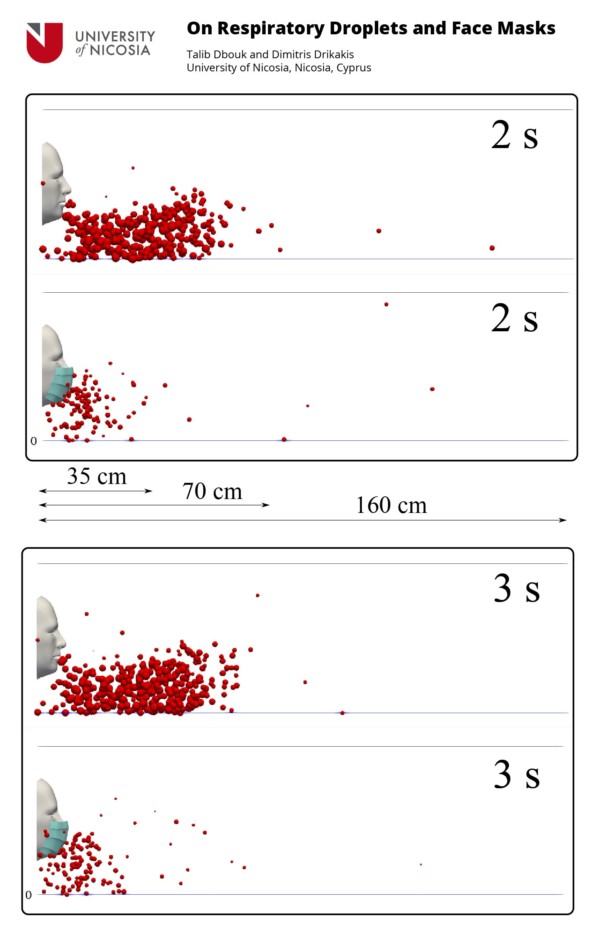
Figure 1
A subject coughing in a cyclic incidence. A qualitative examination of airborne droplet transmission with and without wearing a surgical mask. The top and bottom figures show the results at 2 s and 3 s, respectively. Wearing a surgical mask that exhibits an initial efficiency of ∼91%. This cannot prevent the transport of the saliva droplets away from the subject. Many droplets penetrate the mask shield and some saliva droplet disease-carrier particles can travel more than 1.2 m. For visualization, the droplets were scaled by a factor of 600 compared to their actual size. The environmental conditions are zero wind speed, ambient temperature 20 ○C, pressure 1 atm, and relative humidity 50%. The mouth temperature is 34 ○C and the face skin temperature is 32 ○C.
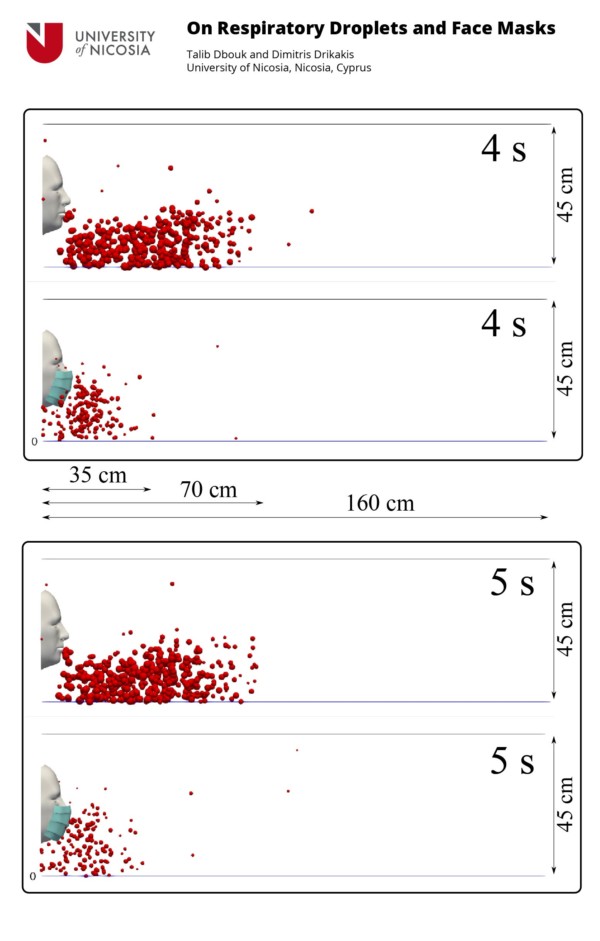
Figure 2
A subject coughing in a cyclic incidence. A qualitative examination of airborne droplet transmission with and without wearing a surgical mask. The top and bottom figures show the results at 4 s and 5 s, respectively. Wearing a surgical mask that exhibits initial efficiency of ∼91%. This cannot prevent the transport of the saliva droplets away from the subject. Many droplets penetrate the mask shield and some saliva droplet disease-carrier particles can travel more than 1.2 m. For visualization, the droplets were scaled by a factor of 600 compared to their actual size. The environmental conditions are zero wind speed, ambient temperature 20 ○C, pressure 1 atm, and relative humidity 50%. The mouth temperature is 34 ○C, and the face skin temperature is 32 ○ C.
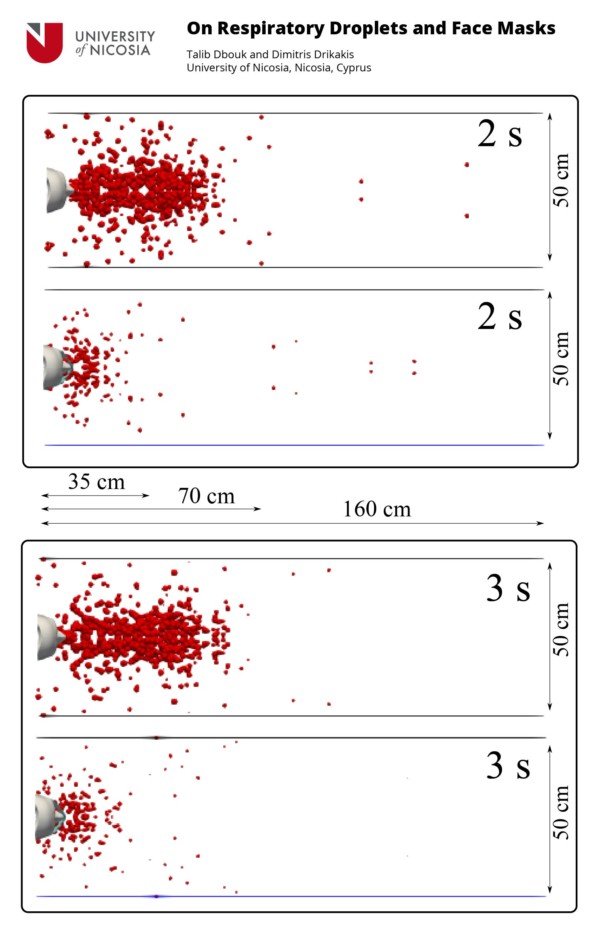
Figure 3
A subject coughing in a cyclic incidence. Top view of a qualitative examination of airborne droplet transmission with and without wearing a surgical mask. The top and bottom figures show the results at 2 s and 3 s, respectively. We consider a surgical mask that exhibits initial efficiency of ∼91%. The cover does not prevent the transport of the saliva droplets entirely away from the subject. Many droplets penetrate the mask shield, and some saliva droplet disease-carrier particles can travel more than 1.2 m. For visualization, the droplets were scaled by a factor of 600 compared to their actual size. The environmental conditions are zero wind speed, ambient temperature 20 ○C, pressure 1 atm, and relative humidity 50%. The mouth temperature is 34 ○C, and the face skin temperature is 32 ○C.
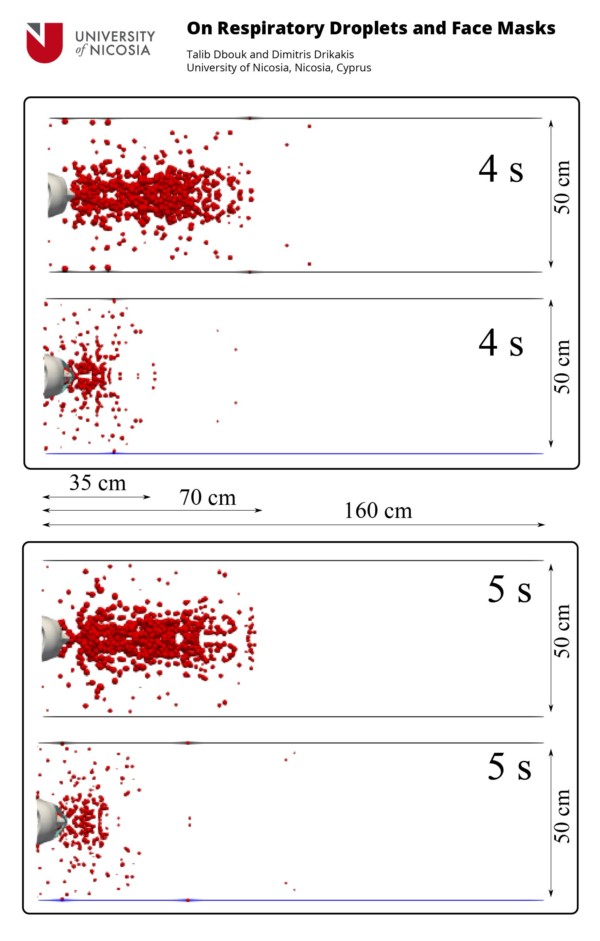
Figure 4
A subject coughing in a cyclic incidence. Top view of airborne droplet transmission with and without wearing a surgical mask. The top and bottom figures show the results at 4 s and 5 s, respectively. We consider a surgical mask that exhibits an initial efficiency of ∼91%. The cover does not prevent the transport of the saliva droplets entirely away from the subject. Many droplets penetrate the mask shield and some saliva droplet disease-carrier particles can travel more than 1.2 m. For visualization, the droplets were scaled by a factor of 600 compared to their actual size. The environmental conditions are zero wind speed, ambient temperature 20 ○C, pressure 1 atm, and relative humidity 50%. The mouth temperature is 34 ○C, and the face skin temperature is 32 ○C.
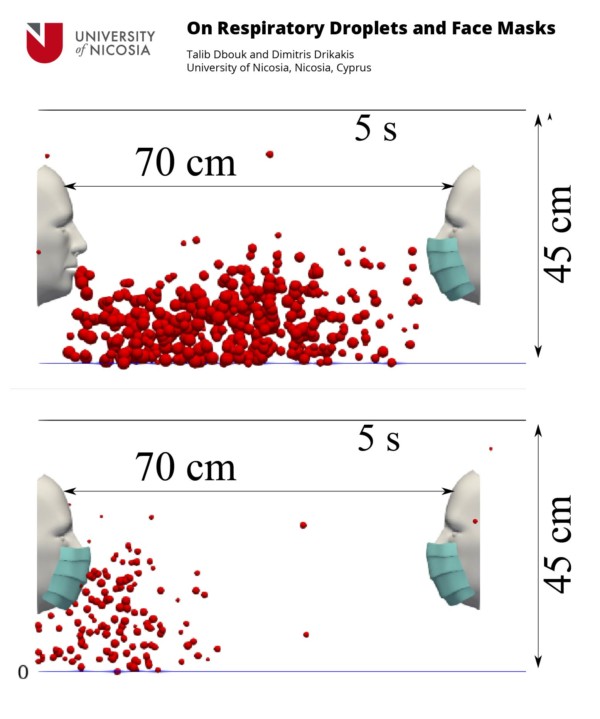
Figure 5
Mask wearer: subjects wearing a mask will reduce the respiratory droplet transmission while (partially) shielding themselves from other subjects experiencing a coughing incident. We show the results at 5 s simulation time for a surgical mask exhibiting an initial efficiency of ∼91%. The environmental conditions are zero wind speed, ambient temperature 20 ○C, pressure 1 atm, and relative humidity 50%. The mouth temperature is 34 ○C and the face skin temperature is 32 ○C.
What Does This Mean?
According to the results of this study, the authors made recommendations that are summarised below:
- Although masks will reduce the droplet transmission, we should not ignore that several droplets will be transmitted away from the mask. The use of a mask will not provide complete prevention from airborne droplet transmission. The above is particularly important, both for indoor and outdoor environments. As Dbouk and Drikakis showed in a previous study (https://aip.scitation.org/doi/10.1063/5.0011960) respiratory droplets can be transmitted to several meters away from the subject due to wind conditions. Therefore, social distancing remains essential when facing an evolving pandemic.
- The above recommendation implies that we can protect healthcare workers only if we equip them with a complete PPE, e.g., completely a helmet with a built-in air filter, a face shield together with a disposable suit over the whole ensemble and a double set of gloves.
- The manufacturers and regulatory authorities should consider new criteria for assessing mask performance, to account for the flow physics and cough dynamics. The authors provided a simple criterion that takes into account the efficiency reduction during a cyclic coughing incident.
Video 1
A subject coughing in a cyclic incidence. A qualitative examination of airborne droplet transmission with and without wearing a surgical mask.
Media and Press Materials
In English
In Greek
The University of Nicosia (UNIC)
About the University of Nicosia
The University of Nicosia (UNIC) is the largest university in Cyprus, and the largest university in southern Europe that teaches primarily in English, welcoming 12,000+ students from over 70 countries worldwide. The University of Nicosia is a comprehensive university with 6 schools, 20 departments and over 100 degree programs offered on-campus and online.
The University of Nicosia is best known in the fields of medicine, law, blockchain, accounting, education, forecasting and international relations and for a series of partnerships with other leading European universities. UNIC was most recently ranked #106 in its region by QS and #300 to #400 globally in the Times Higher Education Impact rankings.
To learn more about the University of Nicosia, please see: https://www.unic.ac.cy/
UNIC’s COVID-19 Response
University of Nicosia faculty across a variety of academic disciplines are actively engaged in research and analysis and serving in scientific / public policy roles supporting the global COVID-19 response.
For more information about the University of Nicosia’s work relating to COVID-19 including potential collaboration, please see: https://www.unic.ac.cy/coronavirus/
Contact Information
For more information about this study, please contact Prof Dimitris Drikakis at [email protected].
For more information on our COVID-19 related research in general, please contact UNIC at [email protected].
Press Coverage
Articles and press mentions in global media about the research.
Έρευνα: Μέχρι ένα μέτρο μπορούν να φτάσουν τα σταγονίδια από βήχα παρά τη χρήση μάσκας
Οι ερευνητές χρησιμοποίησαν υπολογιστικά μοντέλα για να «χαρτογραφήσουν» με ακρίβεια την αναμενόμενη εκτίναξη σταγονιδίων από έναν άνθρωπο με μάσκα, ο οποίος βήχει κατ' επανάληψη Η χρήση μάσκας προσώπου, παρόλο που επιβραδύνει την εξάπλωση του ιού, δεν «δουλεύει» πάντα καλά, ιδίως όταν βήχει συχνά αυτός που τη φοράει. Μια νέα μελέτη, με επικεφαλής έναν Έλληνα επιστήμονα στην Κύπρο, εκτιμά ότι μικρά μεμονωμένα σταγονίδια σάλιου μπορούν να πεταχτούν από τις άκρες της μάσκας και να φθάσουν σε απόσταση ακόμη και έως ενός [...]

Κορονοϊός – Νέα έρευνα για τη μάσκα: Μέχρι ένα μέτρο μπορεί να φθάσουν τα…
Κορονοϊός - Νέα έρευνα για τη μάσκα: Μέχρι ένα μέτρο μπορεί να φθάσουν τα σταγονίδια του βήχα Η μελέτη αναφέρει ότι η αποτελεσματικότητα της μάσκας μειώνεται όσο συνεχίζεται ο βήχας. Η χρήση μάσκας προσώπου, παρόλο που επιβραδύνει την εξάπλωση του ιού, δεν "δουλεύει" πάντα καλά, ιδίως όταν βήχει συχνά αυτός που τη φοράει. Μια νέα μελέτη, με επικεφαλής έναν Έλληνα επιστήμονα στην Κύπρο, εκτιμά ότι μικρά μεμονωμένα σταγονίδια σάλιου μπορούν να πεταχτούν από τις άκρες της μάσκας και να φθάσουν [...]
Κορονοϊός: Ακόμα και με μάσκα ο βήχας διασπείρει σταγονίδια του ιού!
Κορονοϊός: Ακόμα και με μάσκα ο βήχας διασπείρει σταγονίδια του ιού! Η αποτελεσματικότητα της μάσκας είναι μειωμένη, σύμφωνα με την μελέτη Η χρήση μάσκας προσώπου, παρόλο που επιβραδύνει την εξάπλωση του κορονοϊού, δεν «δουλεύει» πάντα καλά, ιδίως όταν βήχει συχνά αυτός που τη φοράει. Μια νέα μελέτη, με επικεφαλής έναν Έλληνα επιστήμονα στην Κύπρο, εκτιμά ότι μικρά μεμονωμένα σταγονίδια σάλιου μπορούν να πεταχτούν από τις άκρες της μάσκας και να φθάσουν σε απόσταση ακόμη και έως ενός μέτρου. Οι ερευνητές, [...]
The Shocking New Way Coronavirus Can Break Through Your Face Mask
You should be wearing a protective face covering whenever you are around other people in order to prevent the spread of COVID-19. However, according to new research, you may still be compromising not only your health, but the health of others, if you aren't standing six feet apart. A new study courtesy of Talib Dbouk and Dimitris Drikakis, from the University of Nicosia in Cyprus and published in Physics of Fluids, claims that the virus can still spread when a [...]
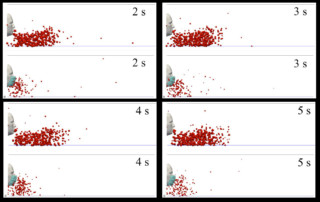
Repeated coughing seriously degrades face mask efficiency
Face masks are thought to slow the spread of viruses, including the novel coronavirus that causes COVID-19, but little is known about how well they work. In an issue of Physics of Fluids, Talib Dbouk and Dimitris Drikakis, from the University of Nicosia in Cyprus, use precise computer models to map out the expected flow patterns of small droplets released when a mask-wearing person coughs repeatedly. Previous work from this research group showed droplets of saliva can travel 18 feet [...]

Coronavirus: la tosse danneggia le mascherine, le goccioline viaggiano fino a un metro – Meteo Web
Coronavirus: la tosse danneggia le mascherine, le goccioline viaggiano fino a un metro - Meteo Web Una ricerca pubblicata su “Physics of Fluids“, condotta da Talib Dbouk e Dimitris Drikakis dell’Università di Nicosia a Cipro, ha elaborato modelli computerizzati per mappare il flusso delle goccioline emesse quando una persona che indossa una mascherina chirurgica tossisce ripetutamente. I ricercatori hanno scoperto che gli attacchi di tosse danneggiano la capacità filtrante dei dispositivi di protezione, consentendo alle goccioline di raggiungere fino a [...]

Repeated coughing adversely affects filtering efficiency of face masks
Repeated coughing adversely affects filtering efficiency of face masks Reviewed by Emily Henderson, B.Sc.Jun 16 2020 Face masks are thought to slow the spread of viruses, including the novel coronavirus that causes COVID-19, but little is known about how well they work. In an issue of Physics of Fluids, by AIP Publishing, Talib Dbouk and Dimitris Drikakis, from the University of Nicosia in Cyprus, use precise computer models to map out the expected flow patterns of small droplets released when [...]

Coronavirus can still pass between face mask wearers — even when they’re 4 feet apart: study | Fox News
Coronavirus can still pass between face mask wearers — even when they're 4 feet apart: study | Fox News COVID-19 can be transmitted between people who are standing more than four feet apart, even if they are wearing a mask, a new study has found. The research, published in Physics of Fluids, notes that face coverings alone do not prevent droplets of fluid that are projected by a cough, a discovery the researchers called "alarming." It adds to the importance to [...]
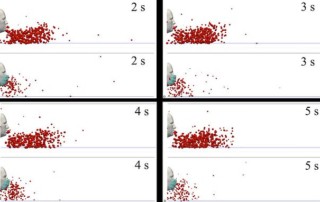
COVID-19 can pass between people up to THREE FEET even with a mask | Daily Mail Online
COVID-19 can pass between people up to THREE FEET even with a mask Coronavirus is able to pass between two people standing up to three feet apart even if one of them is wearing a surgical grade face mask, a new study warns. Researchers from the University of Nicosia in Cyprus also found that masks became even less efficient when people repeatedly cough into them. Scientists say the findings are 'alarming' - and underline the importance of keeping the 6ft [...]

Study Claims Wearing Face Masks May Not Prevent COVID-19 Infection – Sputnik International
Study Claims Wearing Face Masks May Not Prevent COVID-19 Infection - Sputnik International New research suggests that the COVID-19 coronavirus can be transmitted from person to person even if wearing a face mask and while standing more than four feet away from each other. In a study described by the authors as "alarming" and published in the journal Physics of Fluids on Tuesday, it has been suggested that face coverings alone do not block fluid droplets projected by a cough from entering [...]