

COVID-19 Research, January 2021
On Airborne Virus Transmission in Confined Spaces
Talib Dbouk and Dimitris Drikakis, University of Nicosia. Published in Physics of Fluids on 26 January 2021.
The Study
The impact of air ventilation systems on airborne virus transmission, and aerosols in general, in confined spaces, is not yet understood.
The recent pandemic has made it crucial to understand the limitations of ventilation systems regarding virus transmission.
Let us consider an elevator as a prototypical example of a confined space and show how ventilation designs alone, regardless of cooling or heating, contribute to the airborne virus transmission.
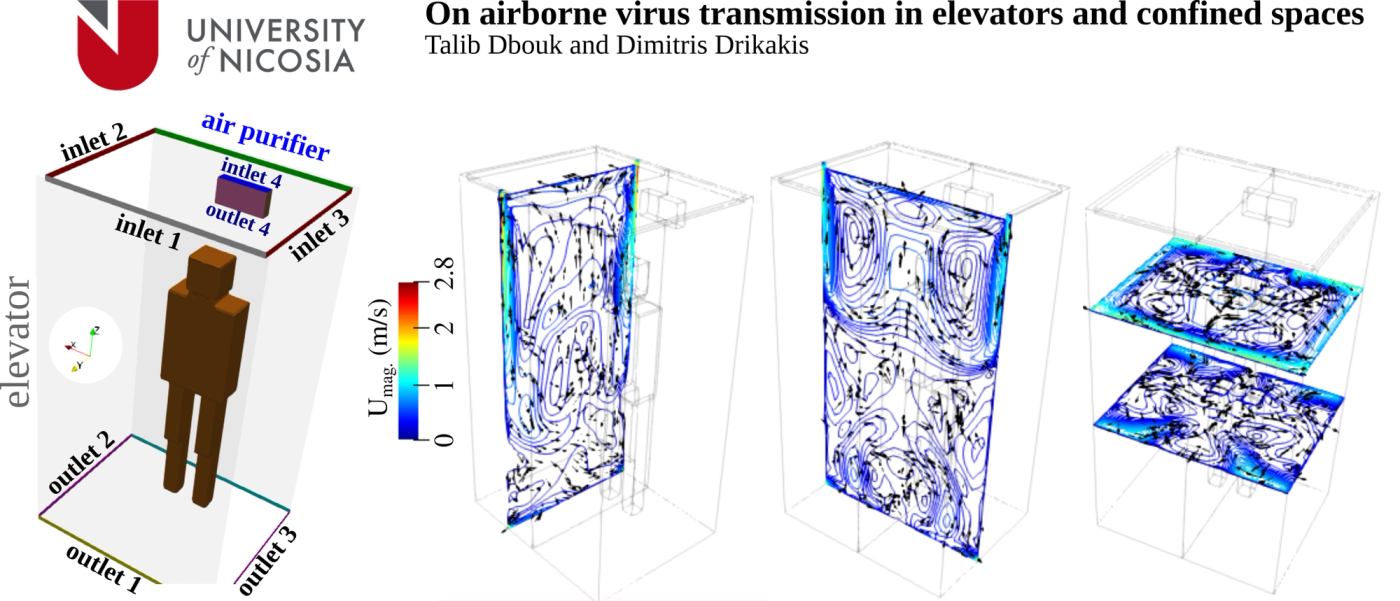
In this study, we investigated air circulation effects inside an elevator by employing advanced multiphase computational fluid dynamics. We were interested in the performance of an air purifier installed in an elevator for reducing airborne virus transmission.
For the above reasons, we have investigated three different flow scenarios regarding the position and operation of inlets and outlets inside the elevator, and a fourth scenario that includes the operation of the air purifier.
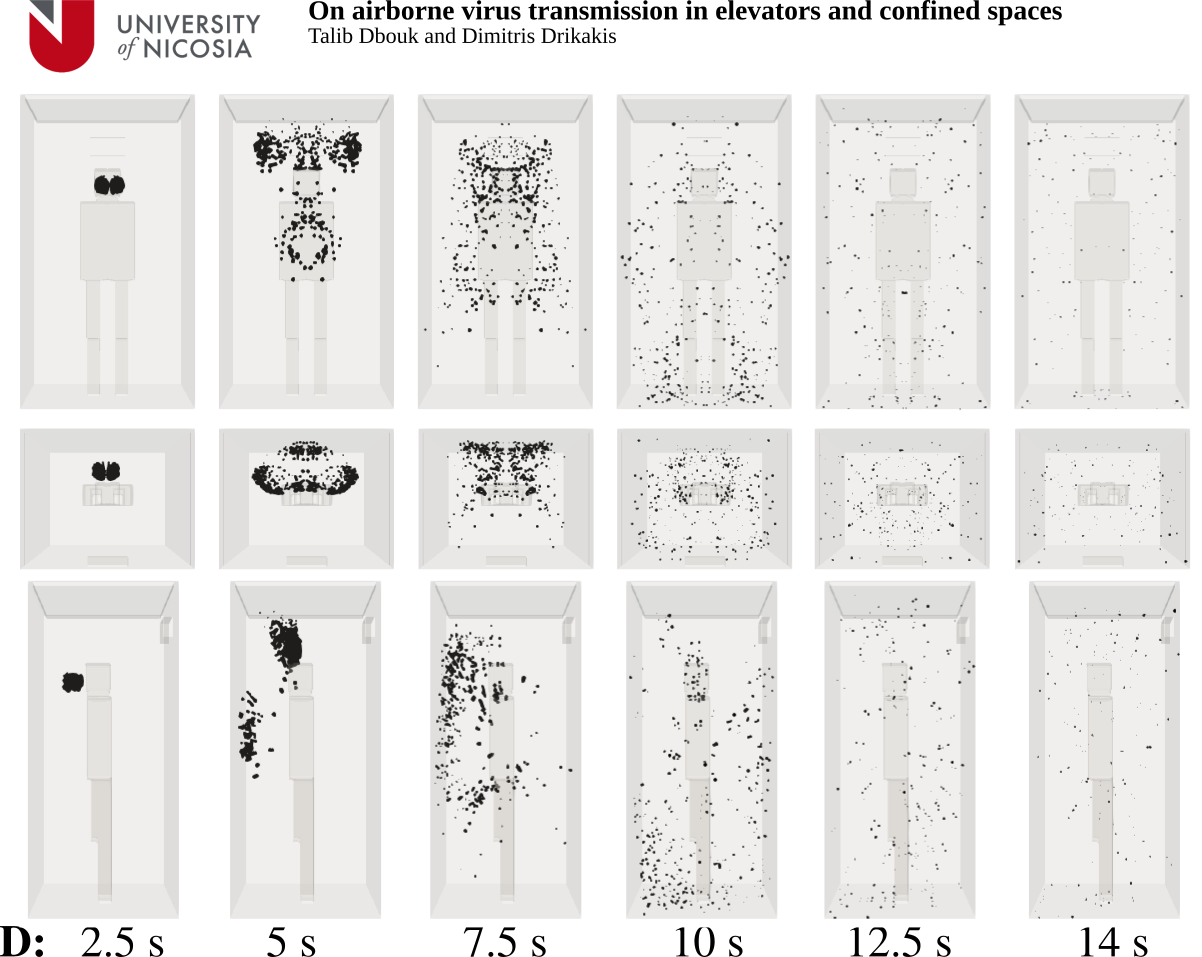
Interestingly, we found that the position of the inlets and outlets significantly influences the flow circulation and droplet dispersion. More importantly, we found that an air purifier installed inside an elevator does not eliminate airborne virus transmission.
Dbouk, T. and Drikakis, D. On airborne virus transmission in elevators and confined spaces. Physics of Fluids 33, 011905 (2021), published online 26 January 2021. doi.org/10.1063/5.0038180
What Does This Mean?
In confined spaces such as an elevator, the placement of ventilation inlets and outlets significantly influences the flow circulation and droplet dispersion. Without an air purifier, the case of a single inlet and outlet exhibits the least droplet dispersion. The subject’s position inside the cabin also influences the flow circulation and droplet spread. The air purifier reduces the droplet dispersion but will not eliminate it. The air intake integrated inside the purifier equipment induces flow circulation that can add to the contaminated saliva droplets in the cabin. The time required for droplets reaching the elevator floor could be larger than the time necessary to deactivate the virus by other means such as UV radiation. Thus, the success of air purifiers lies in addressing the issue mentioned above. The present study’s results are pertinent to any confined spaces, including small rooms in residential or commercial facilities, car parks, shops, and an aircraft cabin, submarines, and spacecraft.
The broader implications of the present findings are that health and safety authorities must revise guidelines accordingly by considering the flow circulation and droplet dispersion effects from air purifiers and sanitisers in confined spaces. The design of future ventilation and purification systems should reduce airborne virus transmission through minimisation of droplet dispersion.
Videos
The simulations published with the paper. Each opens as a video file in the browser.
- Video 1 (MP4): Contaminated saliva droplets dispersion inside an elevator’s cabin due to an operating air purifier: The air purifier induces local air circulations represented by the velocity contours isosurfaces. The contaminated saliva droplets are illustrated in black dots.
Media and Press Materials
UNIC’s COVID-19 Response
During the pandemic, University of Nicosia faculty across a range of academic disciplines worked on research and analysis, and served in scientific and public policy roles supporting the COVID-19 response.
The university’s other COVID-19 research is gathered on COVID-19 Research.
Contact Information
For more information about this study, contact Professor Dimitris Drikakis at drikakis.d@unic.ac.cy.
Press Coverage
Articles and press mentions in global media about the research.
- New York Post: Air purifiers may actually help spread of COVID in confined spaces
- Daily Mail: Air purifiers could help to SPREAD Covid-19 in confined spaces, study claims
- Inverse: Physics study reveals one life-saving reason to take the stairs
- Phys.org: Air purifiers may do more harm than good in confined spaces with airborne viruses
- News-Medical: Air purifiers may increase the spread of airborne virus transmission in confined spaces
- Technology Networks: Air Purifiers in Confined Spaces May Actually Increase the Spread of Airborne Viruses
- StudyFinds: Air purifiers may INCREASE airborne virus spread in confined spaces during pandemic
- Newswise: Air Purifiers May Do More Harm Than Good in Confined Spaces with Airborne Viruses
- Labroots: Air purifiers may increase the spread of viral transmission, not hinder it
- Global Biodefense: In Tight Spaces, Air Purifiers May Do More Harm Than Good in Spreading Viruses
- TerraDaily: In confined spaces, air purifiers may actually aid the spread of COVID-19
- Kathimerini Cyprus: Τα συστήματα καθαρισμού αέρα δύναται να αυξήσουν την εξάπλωση των ιών
- Sigmalive: «Τα συστήματα καθαρισμού αέρα δύναται να αυξήσουν την εξάπλωση των ιών»