

COVID-19 Research, June 2020
On Respiratory Droplets and Face Masks
Talib Dbouk and Dimitris Drikakis, University of Nicosia. Published in Physics of Fluids on 16 June 2020.
The Study
Face mask filters, textile, surgical or respiratory, are widely used in the effort to limit the spread of airborne viral infections. Our understanding of the droplet dynamics around a face mask filter, including the droplet containment, leakage from and passing through the cover, is incomplete.
The authors present a fluid dynamics study of the transmission of respiratory droplets through and around a face mask filter. By employing multiphase computational fluid dynamics Dbouk & Drikakis investigate the droplet dynamics induced by a mild coughing incident and examine the fluid dynamics phenomena affecting the mask efficiency. The model takes into account turbulent dispersion forces, droplet phase-change, evaporation, and breakup in addition to the droplet-droplet and droplet-air interactions. The model mimics real events by using data which closely resemble cough experiments.
The study shows that the criteria employed for assessing the face mask performance must be modified to take into account: the penetration dynamics of airborne droplet transmission, the fluid dynamics leakage around the filter, and reduction of efficiency during cough cycles. A new criterion for calculating more accurately the mask efficiency by taking into account the penetration dynamics, is proposed.
We show that the use of masks will reduce the airborne droplet transmission and will also protect the wearer from the droplets expelled from other subjects. However, many droplets still spread around and away from the cover, cumulatively, during cough cycles. Therefore, the use of a mask does not provide complete protection, and social distancing remains important during a pandemic. The implications of the reduced mask efficiency and respiratory droplet transmission away from the mask are even more critical for healthcare workers. The results of this study provide evidence of droplet transmission prevention by face masks, which can guide their use and further improvement.
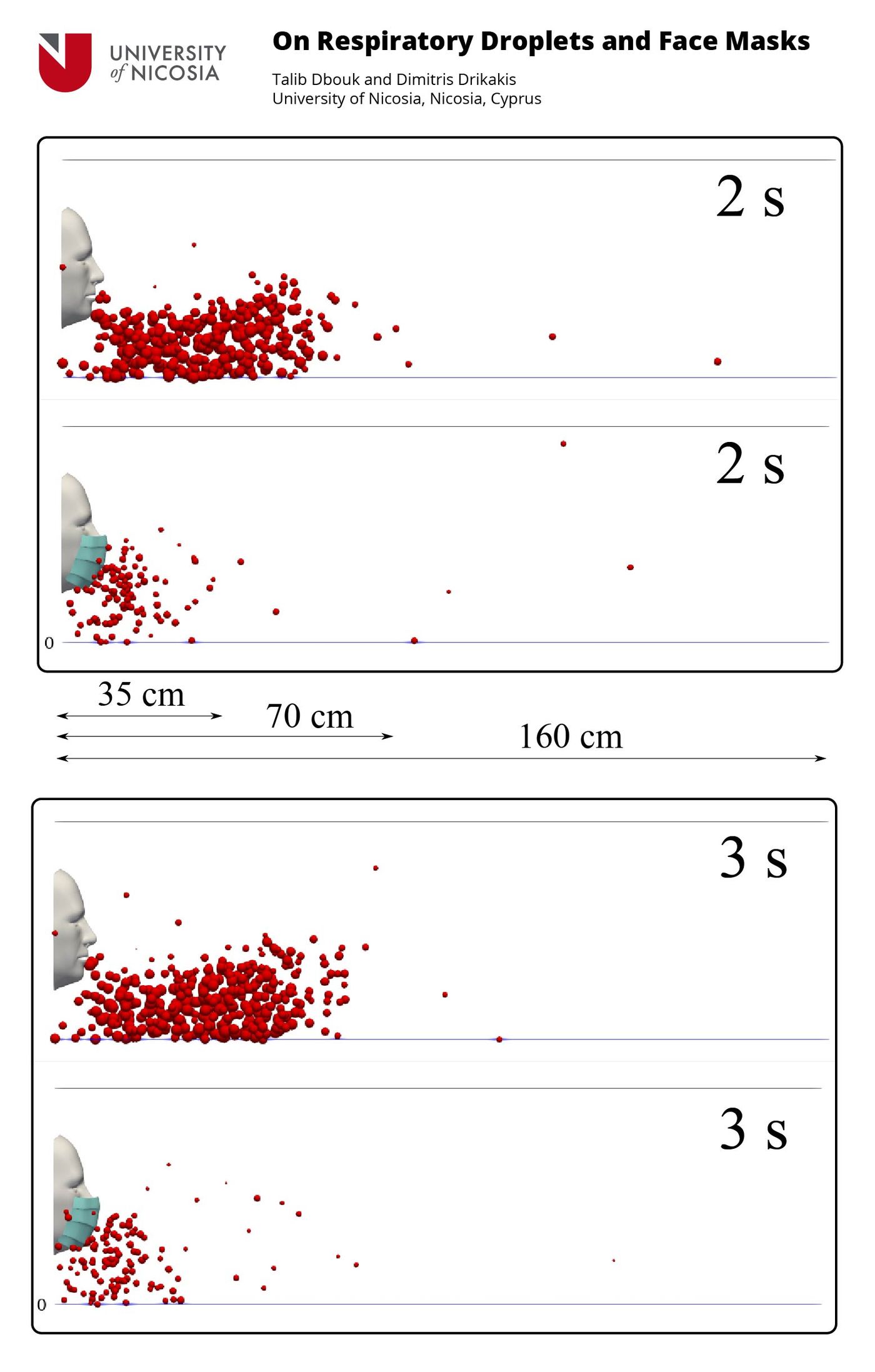
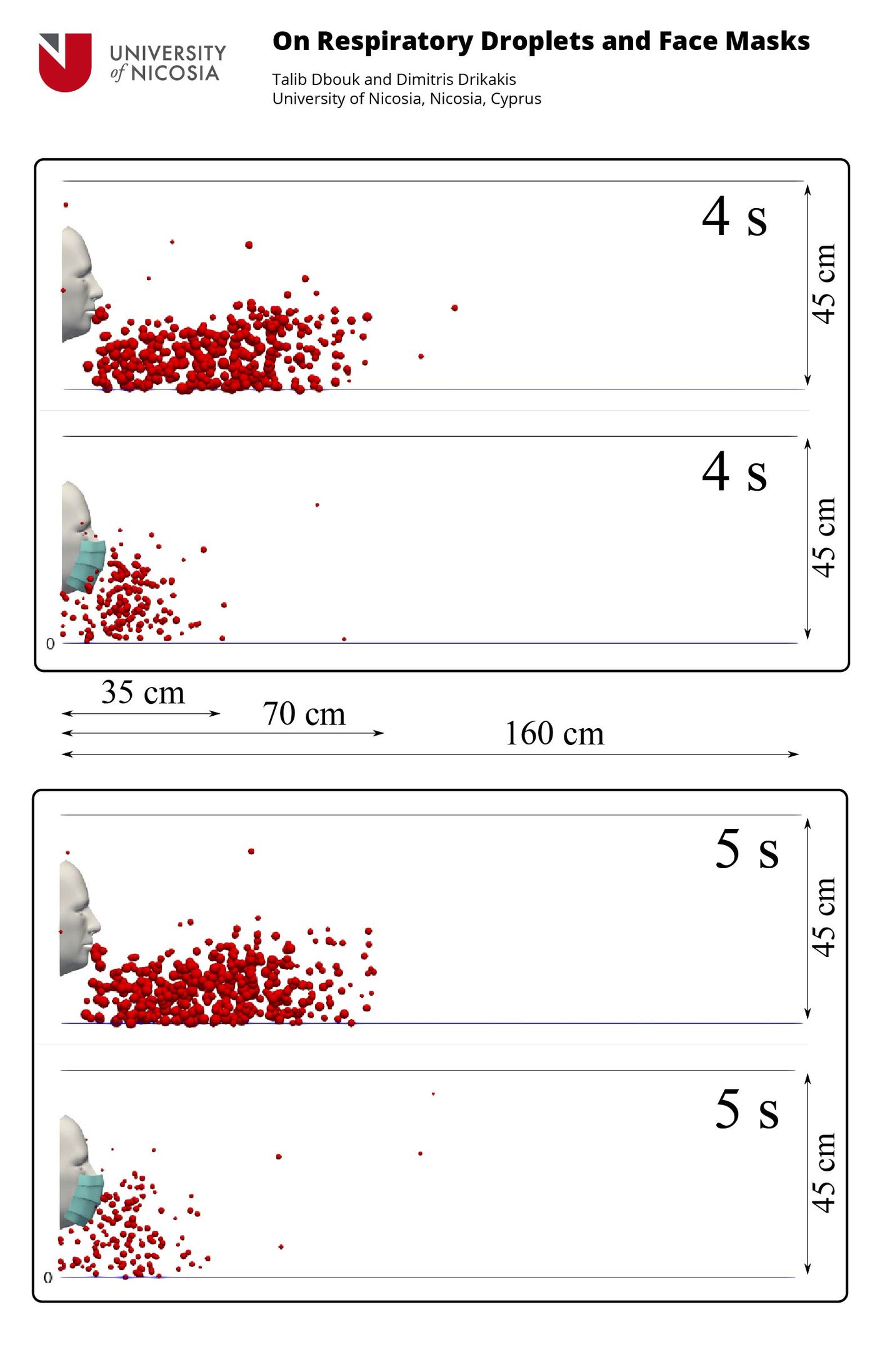
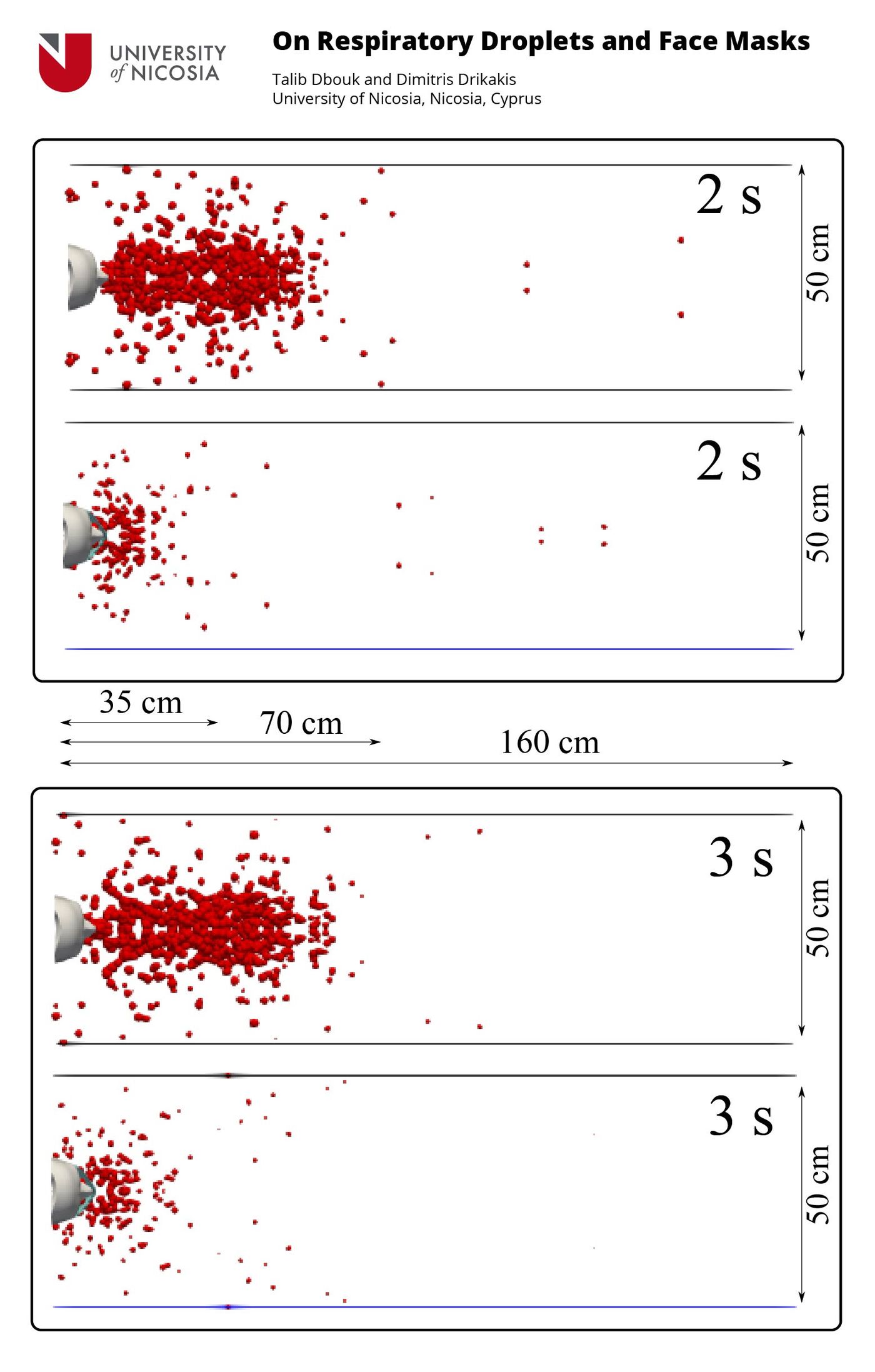
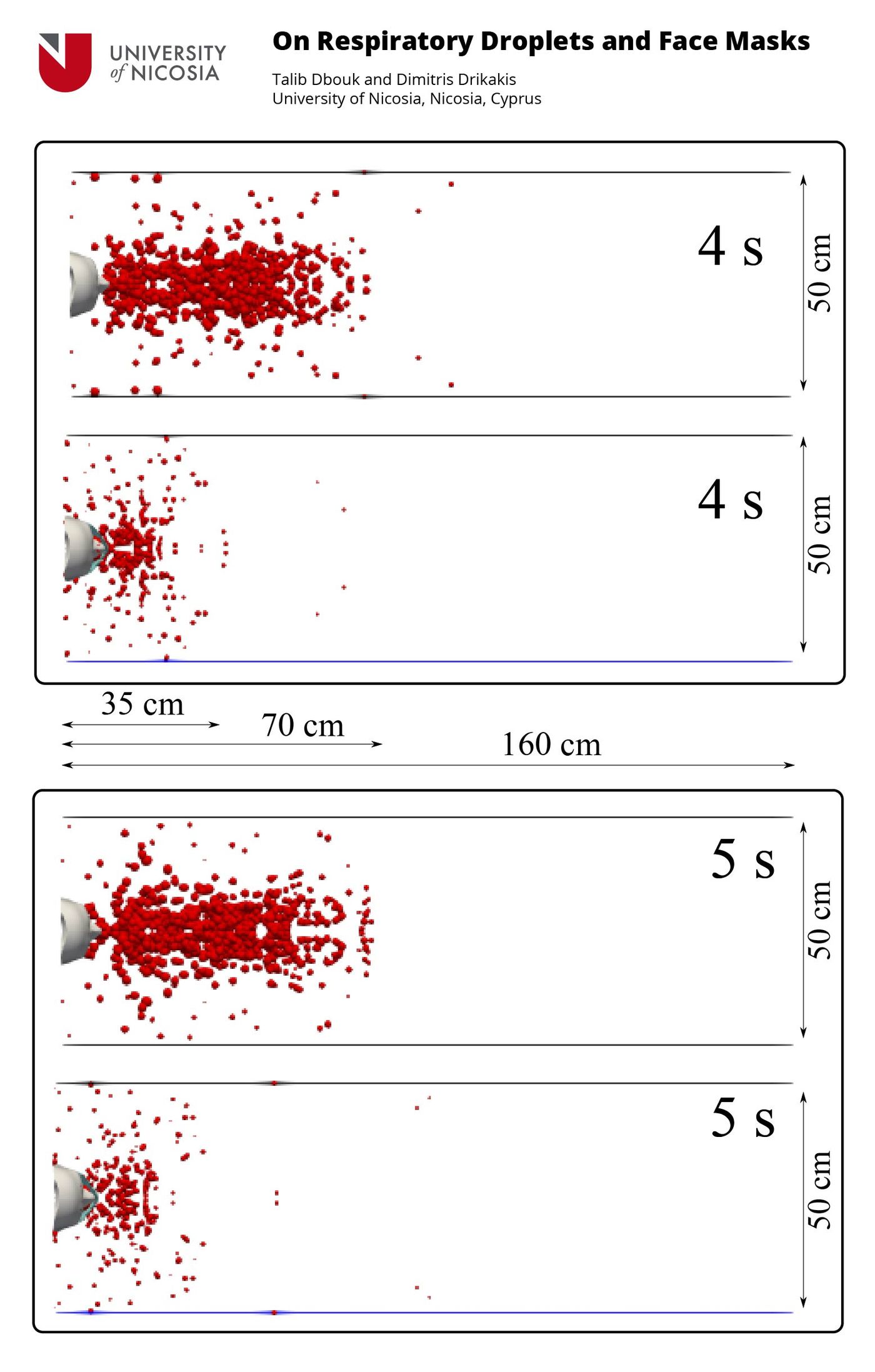
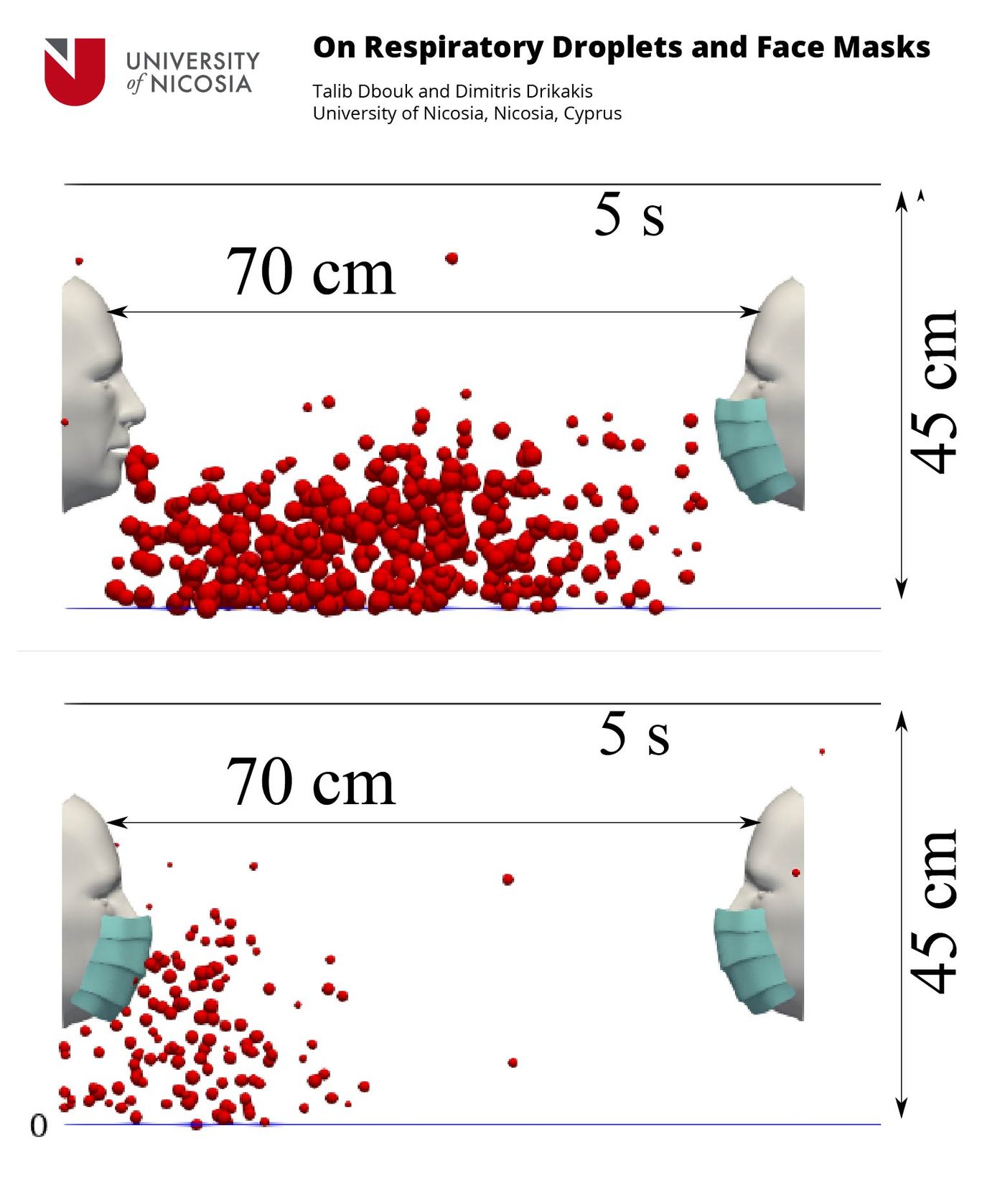
Dbouk, T. and Drikakis, D. On respiratory droplets and face masks. Physics of Fluids 32, 063303 (2020), published online 16 June 2020. doi.org/10.1063/5.0015044
What Does This Mean?
According to the results of this study, the authors made recommendations that are summarised below:
- Although masks will reduce the droplet transmission, we should not ignore that several droplets will be transmitted away from the mask. The use of a mask will not provide complete prevention from airborne droplet transmission. The above is particularly important, both for indoor and outdoor environments. As Dbouk and Drikakis showed in a previous study (https://aip.scitation.org/doi/10.1063/5.0011960) respiratory droplets can be transmitted to several metres away from the subject due to wind conditions. Therefore, social distancing remains essential when facing an evolving pandemic.
- The above recommendation implies that we can protect healthcare workers only if we equip them with a complete PPE, e.g., completely a helmet with a built-in air filter, a face shield together with a disposable suit over the whole ensemble and a double set of gloves.
- The manufacturers and regulatory authorities should consider new criteria for assessing mask performance, to account for the flow physics and cough dynamics. The authors provided a simple criterion that takes into account the efficiency reduction during a cyclic coughing incident.
Videos
The simulations published with the paper. Each opens as a video file in the browser.
- Video 1 (MP4): A subject coughing in a cyclic incidence. A qualitative examination of airborne droplet transmission with and without wearing a surgical mask.
Media and Press Materials
UNIC’s COVID-19 Response
During the pandemic, University of Nicosia faculty across a range of academic disciplines worked on research and analysis, and served in scientific and public policy roles supporting the COVID-19 response.
The university’s other COVID-19 research is gathered on COVID-19 Research.
Contact Information
For more information about this study, contact Professor Dimitris Drikakis at drikakis.d@unic.ac.cy.
Press Coverage
Articles and press mentions in global media about the research.
- Fox News: Coronavirus can still pass between face mask wearers, even when they're 4 feet apart: study
- Daily Mail: COVID-19 can pass between people up to THREE FEET even with a mask
- The Irish Times: Covid-19: Face masks alone not enough to protect against coughing, research finds
- Physics World: Toilets could be flush with coronavirus, masks struggle to contain repeated coughs
- The Economic Times: Is your face mask protecting you? Repeated coughing 'adversely affects' filtering capacity
- The Tribune: Filtering capacity of face masks 'adversely affected' by repeated coughing, study says
- The Financial Express: COVID-19: Filtering capacity of face masks 'adversely affected' by repeated coughing, study says
- The Province: Consistent coughing degrades mask filters
- WPTV: Keep your distance; new study on coughing shows masks help, not perfect
- Medical Xpress: Repeated coughing seriously degrades face mask efficiency
- News-Medical: Repeated coughing adversely affects filtering efficiency of face masks
- Euronews: Έρευνα: Ακόμη και με μάσκα τα σταγονίδια ανθρώπου που βήχει μπορεί να φτάσουν μέχρι το ένα μέτρο
- in.gr: Νέα έρευνα: Έως ένα μέτρο φτάνουν σταγονίδια ανθρώπου με μάσκα που βήχει