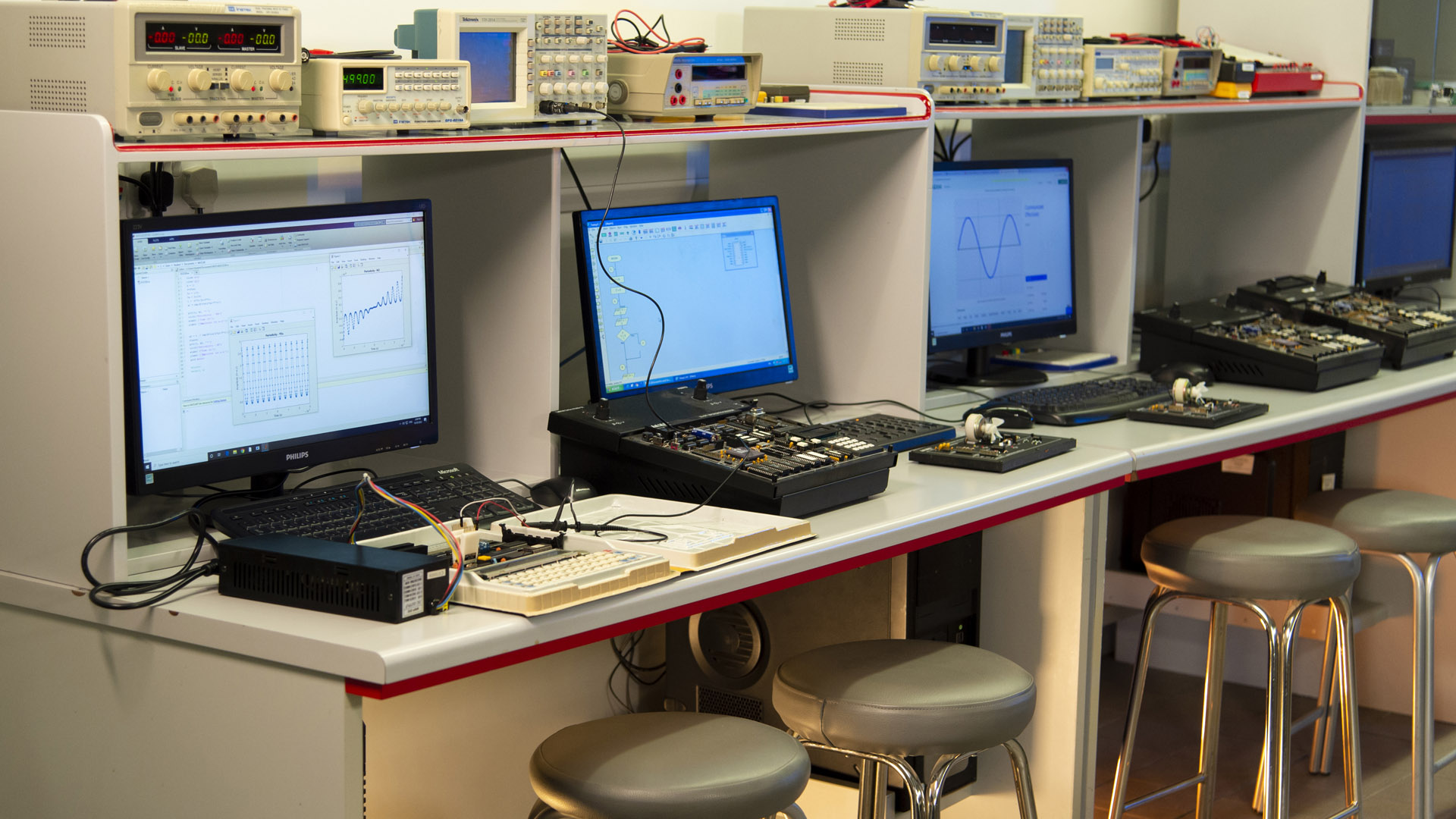
The Electrical and Computer Engineering Laboratory is located at the Research & Technology Building. It serves the educational needs of the students as well as the research needs of the faculty. It is equipped with state of the art equipment, 8 workstations where a maximum of 16 students may work at a time, a number of personal computers running specialized engineering software, a video projector, as well as a live broadcasting system. The laboratory is organized in eight sections each covering different areas of the two disciplines.
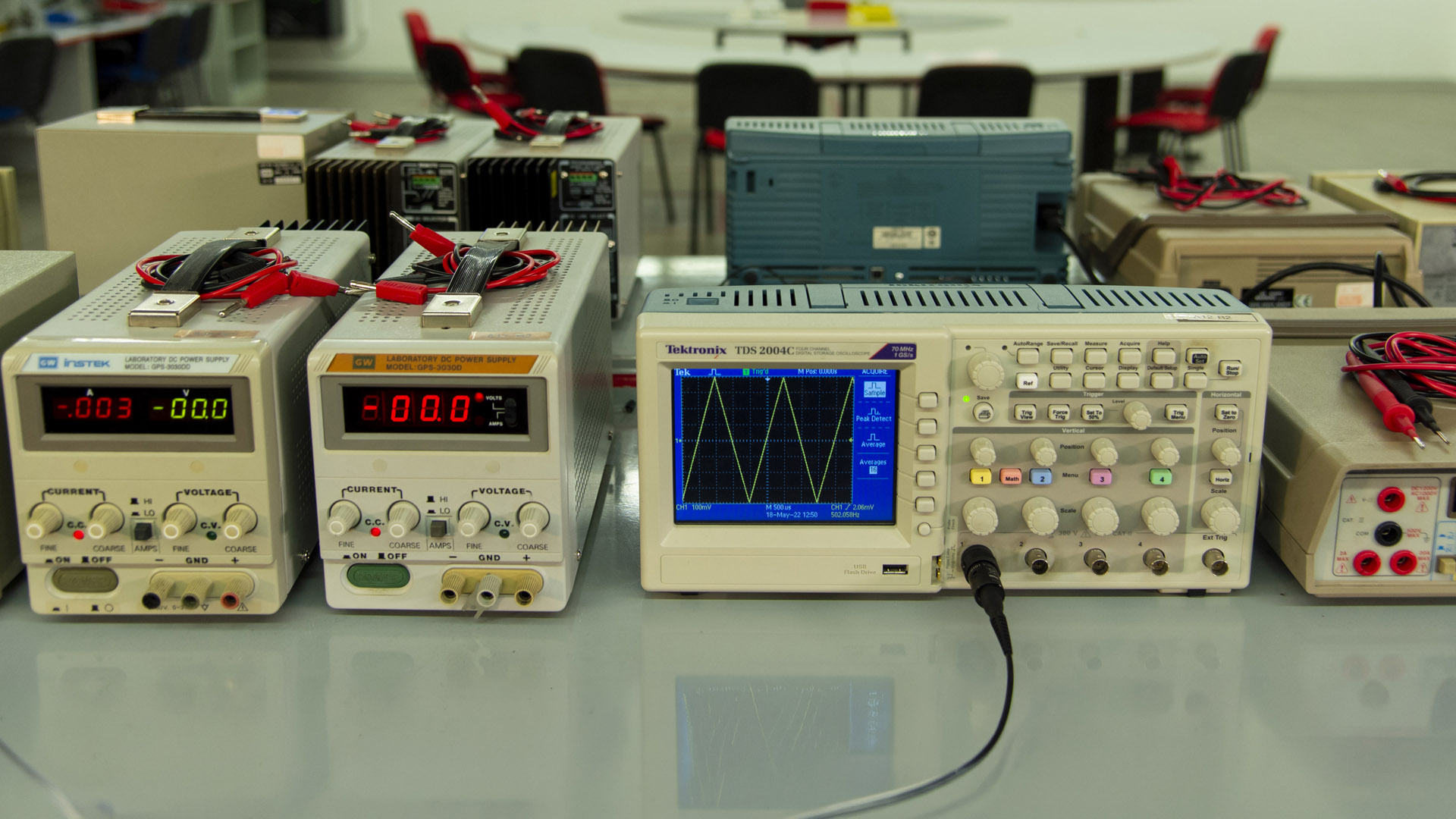
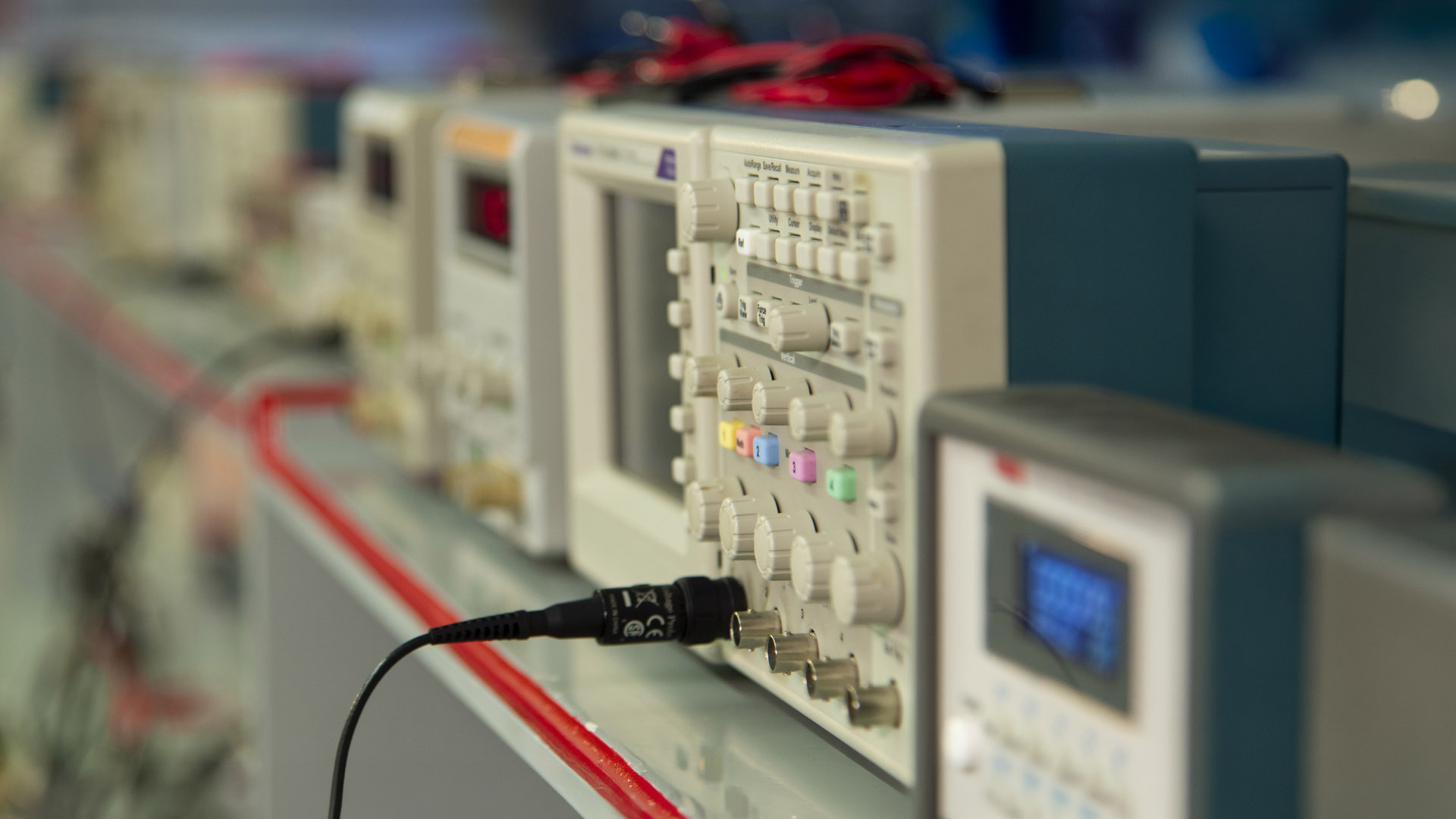
The Electric Circuits and Electronics section is equipped with state-of-the-art equipment for instrumentation, measurements and manufacturing provides students with the necessary tools to develop, test and troubleshoot modern electric and electronic circuits from prototype to finished product. Among others, this section is equipped with analogue and digital oscilloscopes, mixed signal oscilloscopes, spectrum analyzers (up to 3 GHz), RF generators/counters, function generators, digital power supplies, programmable LC meters, hand-held multi-meters, etc. Furthermore, the section is equipped with a magnetic/ electrostatic field meter, a magnetic field dosimeter, a hand-held spectrum analyzer, electrometer, conductivity meter, insulation meter, temperature meter, light meter and chronometers.
The Digital Circuits section where students become acquainted with the design and testing of basic and advanced digital circuits, and with integrating these components into digital systems. Intel DE10-Lite board with Altera MAX10 FPGA boards and Quartus Prime Lite software are readily available to the students. Furthermore, a discrete components section includes a number of microchips of the 74HCXX family as well as an educational ETS-7000A/B Digital – Analog Training System Unit. Single board microcomputer kits introduce students to the design and programming of microprocessors. Various interfacing units such as step-motors, dynamic scanning boards, 16X16 DM Displays and Opto-Couples are available. In addition, software for fault-assisted circuits for electronics training, accompanies the digital circuits and microprocessors hardware.
The Microprocessors section is equipped with FACET 32-bit (80386DX CPU) training units by LABVOLT, as well as 8-bit microprocessor systems with application boards, enabling comprehensive study of microprocessor architecture, memory, and input/output operations. The facilities support communication with analog systems through A/D and D/A converters and allow students to perform experiments on bus operations, data transfers, addressing modes, interrupts, instruction execution, and system initialization. In addition, students develop practical skills in measuring and analysing signals from processors and their associated chipsets, as well as interfacing with external devices such as sensors, displays, and motor control systems. The section supports a range of applied experiments, including real-time programming, signal processing, and troubleshooting, providing a strong foundation in both theoretical concepts and practical implementation.
The Electronic Communications section where experimental units are provided for the analysis of analogue and digital communication systems. Training is provided in generation, modulation, transmission and reception of analogue and digital signals for various modulation schemes. Among others, this section includes trainers in superheterodyne receiver, single sideband, phase locked loop and frequency synthesizer as well as computer-based digital communication trainer.
The Fiber Optics Communications section where FACET (Fault-Assisted Circuitry in Engineering Training) modules are capable of a series of experiments that provide a first, hands-on experience with the point-to-point (P2P) optical communication link. The experiments expose students to the necessary subsystems that comprise such a communication link and include the generation, preparation, transmission and reception of an analog sound signal as well as digital signals under a variety of encoding schemes. In addition, there are experiments that call for students to actually cut and polish the optical fiber realizing the important role these actions have on the link’s performance. Lastly, FACET modules, are also capable to strategically inject faults in a number of subsystems which the students are called to troubleshoot, isolate and eliminate. The process assists the student to gain a deeper understanding on the purpose of each subsystem block has on the communication link.
The Data Communications and Computer Networks section where a number of machines run OPNET (licensed) and NS3 (open-source) software packages on Linux environments. These packages provide students with a means for understanding the basic layered network approach on a networks that involve both wired and wireless environments. The supported experiments engage students in the development of models for the network node, the network link, the network topology and the offered traffic, and, via simulation executions, provide quantitative performance analysis on preselected and custom protocol stack designs.
The Controls and Educational Robotics section is equipped with a process-control trainer hardware with control simulator software and educational robots are available for measurements and experimentation by students. Constructive setups can be developed using flexible educational robotics structures to perform robotic and control experiments varying from basic proof-of-concept emulating environments to advanced measurement in innovative control environments. The basic structures can be enriched by various available sensor devices to measure magnetic field, light, color, temperature, etc. Moreover, devices such as IR seeker receivers, gyroscopes, accelerometers, Bluetooth and WiFi dongles, Vision Systems extend their capabilities for measurements and communication covering many contemporary applications in the fields of Electrical and Computer Engineering.
The Power Systems section is equipped with electromechanical and power electronics training systems that cover all major types of electrical machines, including transformers, DC and AC motors, and synchronous generators operating under standard grid conditions. The facilities support the study of motor control and industrial automation through power electronic modules, including thyristor-controlled rectifiers and IGBT-based converters for DC and three-phase power applications. Accompanied by measurement instruments such as torque meters and speed sensors, the systems enable students to perform experiments related to power generation, transmission, and utilization, while also simulating real industrial processes through computer-based data acquisition. The division supports advanced coursework in electric machines, power systems, and energy management, providing practical understanding of both domestic and industrial power applications.
A series of most common machines all of 200 W ratings are listed below:
Type of machine/device in modules: Common application
- DC – motor/generator: Home used hand held drills, bicycle dynamos to produce light
- Universal motor: Kitchen mixers, hair dryers
- Single phase induction motor: Refrigerator – air conditioners – pressure water pumps motors
- Three phase asynchronous motors: Usual production line factory motors
- Synchronous motor/generator: High power motors extracting from mines coal, stones etc. Typical power station generators synchronized with the main power grid
- Specially constructed DC – motor: Acting as a prime mover to drive the generator simulating a real scenario
- Dynamometer rotor: Connecting to a running motor to create a braking torque simulating load
- Transformers: Diverse applications for home appliances but mainly for the power system
- Simulated power transmission line: High voltage transmission line for power system analysis
- Variable 0 – 400V, 5A 3-phase AC supply: To operate the motors and supply constructed Variable 0 – 240V, 5A DC supply model power systems
A further multi-module type training system comprised by power electronics modules is being employed for diverse control operations mainly of the above mentioned electric motors to enhance the industrial automation concept.
Power electronic circuits: Application
- Pulse firing unit to trigger the thyristors of a three phase controlled converter: To program and predetermine the operating routine of DC motors supplied by the three phase AC grid.
- Pulse firing unit to switch through the IGBT transistors of a three phasechopper: To invert solar cells’ low DC voltage to high three phase voltage to supply domestic appliances as well as motors.
Gallery







Facility Details
Type
Engineering Lab
Room
RTA12
Building
Capacity
22