

EU Justice Scoreboard 2026: Cyprus’ Long Road to Judicial Efficiency
The publication of the 2026 EU Justice Scoreboard once again places Cyprus under the European spotlight. As the European Commission’s principal comparative tool for assessing national justice systems, the Scoreboard evaluates the efficiency, quality and independence of justice across all 27 Member States.
For Cyprus, this year’s findings present a mixed and, in some respects, concerning picture. A comparison with the 2025 EU Justice Scoreboard reveals that while important reforms continue to reshape the judicial system, several key efficiency indicators have deteriorated. The estimated duration of both civil-commercial and administrative proceedings increased during the latest reporting period, while the backlog of pending civil and commercial cases also grew. At the same time, Cyprus continues to record exceptionally high clearance rates, modest increases in judicial expenditure and ongoing progress in the digitalisation of justice. These developments suggest that Cyprus remains firmly engaged in a process of judicial modernisation, however, they also highlight the continuing gap between institutional reform and practical outcomes.
Cyprus Continues to Struggle with Judicial Delays
The most persistent concern highlighted by the Scoreboard remains the length of judicial proceedings. In the category of civil and commercial litigation at first instance, Cyprus continues to be among the slowest-performing jurisdictions in the European Union. Figure 5 of the Scoreboard places Cyprus near the bottom of the EU ranking regarding the estimated time required to resolve litigious civil and commercial cases, with only Greece appearing to perform worse.
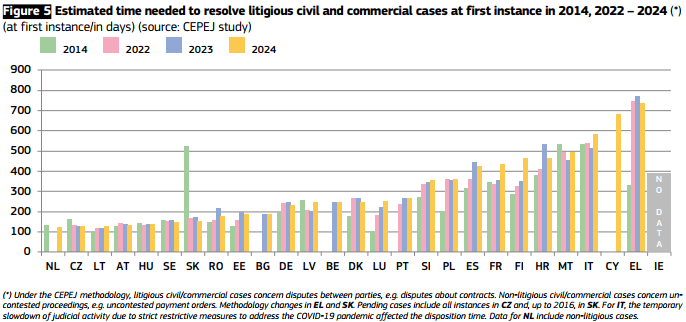
A comparison with the previous edition of the EU Justice Scoreboard in 2025 reveals that Cyprus has not merely maintained its position among the slower-performing Member States but has, in certain respects, experienced further deterioration. In civil and commercial litigation at first instance, the estimated disposition time increased from approximately 520 days in 2023 to nearly 580 days in 2024, while Cyprus remained the second-slowest jurisdiction in the European Union after Greece. The deterioration is even more pronounced in administrative proceedings, where the estimated time required to resolve cases almost doubled, rising from approximately 400 days in 2023 to nearly 800 days in 2024. These developments suggest that the latest Scoreboard does not simply reproduce earlier findings but highlights a worsening of judicial delays in key areas despite ongoing reform efforts.
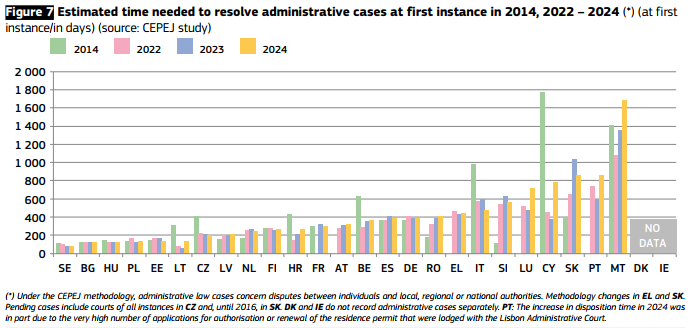
The picture is similarly concerning for administrative justice. Cyprus remains among the Member States requiring the longest time to resolve administrative disputes at first instance. Figure 7 places Cyprus within the group of countries experiencing the greatest delays, alongside Malta, Portugal and Slovakia.
When examining proceedings across all court instances, Cyprus again appears among the slowest jurisdictions in Europe. In both civil-commercial and administrative litigation, the cumulative duration of proceedings remains substantially above the EU average. These findings indicate that, despite extensive reform efforts, the effects of recent legislative and institutional changes have not yet translated into a significant reduction in overall case duration.
A comparison with the 2025 EU Justice Scoreboard reveals a notable deterioration in the estimated time required to resolve administrative cases at first instance. Whereas the previous edition reported a disposition time of approximately 400 days in 2023, the 2026 Scoreboard records a figure approaching 800 days for 2024. This sharp increase suggests that, despite ongoing judicial reforms, administrative justice in Cyprus experienced renewed delays during the latest reporting period.
Positive Signs in Case Resolution Rates
Not all findings are negative. One of the most encouraging indicators concerns Cyprus’ clearance rate – the ability of courts to resolve cases at least as quickly as new cases enter the system.
In the broad category of civil, commercial, administrative and other cases, Cyprus records one of the highest clearance rates among EU Member States. Likewise, in litigious civil and commercial cases, Cyprus appears at the very top of the European ranking. The Scoreboard also notes improvements in administrative proceedings, where the number of resolved cases increased significantly. According to the European Commission, this development was partly attributed to the consolidation and withdrawal of 2,724 cases, as well as the operation of the Administrative Court established in 2015.
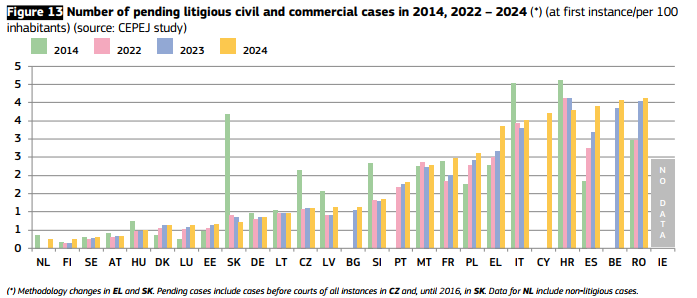
However, a comparison with the 2025 EU Justice Scoreboard reveals that these positive developments have not yet been translated into a reduction of the overall backlog of cases. While Cyprus already recorded one of the highest numbers of pending litigious civil and commercial cases per 100 inhabitants in the 2025 edition, the 2026 Scoreboard shows a further increase in unresolved cases. The number of pending civil and commercial disputes rose from approximately four cases per 100 inhabitants in 2023 to around four and a half in 2024, placing Cyprus among the Member States with the largest outstanding caseloads.
This apparent contradiction highlights the central challenge facing the Cypriot justice system. Although courts are now resolving cases at an impressive rate, they continue to struggle with the accumulation of long-standing backlogs and the volume of incoming litigation. As a result, improved clearance rates have yet to produce a corresponding reduction in pending cases or a significant improvement in the overall duration of proceedings. The 2026 findings, therefore, suggest that judicial reforms are beginning to enhance the courts’ capacity to process cases, but that their full impact on efficiency remains to be seen.
Digitalisation: Progress, But Not Yet Among Europe’s Leaders
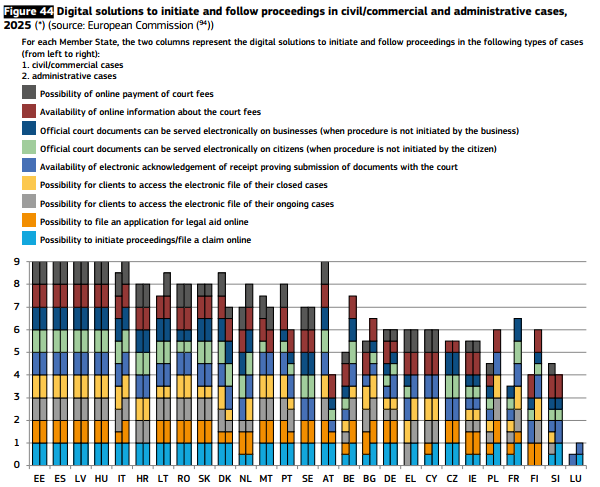
The digitalisation of justice remains a central objective of EU policy. The 2026 Scoreboard dedicates extensive attention to the use of digital technologies, electronic case management systems, online filing procedures, videoconferencing and electronic communication between judicial institutions.
Cyprus continues to demonstrate moderate progress in this area. The country performs reasonably well regarding procedural rules permitting the use of digital technologies in court proceedings and online services for initiating and monitoring cases.
However, a comparison with the 2025 EU Justice Scoreboard suggests that Cyprus’ overall level of digitalisation has remained broadly stable. While the country retains a solid middle-ranking position among EU Member States, it has not yet achieved the level of digital integration observed in several northern and eastern European jurisdictions. Of particular significance is the relatively limited availability of secure electronic communication tools between courts and external actors compared to many of the leading Member States.
Judicial Resources Remain Limited
The Scoreboard also highlights continuing structural resource constraints within the Cypriot justice system. Although public expenditure on courts as a percentage of GDP increased slightly between the 2025 and 2026 editions of the Scoreboard, Cyprus remains the lowest-ranking Member State on this indicator. The modest increase in funding, therefore, appears insufficient to alter Cyprus’ relative position within the European Union.
Similarly, while the number of judges per 100,000 inhabitants has increased over time, Cyprus continues to remain below many European jurisdictions that perform more effectively in terms of case resolution and procedural speed.
Most strikingly, despite a small increase in judicial expenditure, the latest data show worsening delays and growing backlogs in several categories of cases. This suggests that the effects of additional investment have yet to translate into measurable improvements in court efficiency and case management.

A System in Transition
The overall picture emerging from the 2026 EU Justice Scoreboard is neither one of failure nor one of complete success. Cyprus continues to rank among the slowest judicial systems in Europe in several key efficiency indicators. Long proceedings and substantial backlogs remain major challenges that directly affect citizens, businesses and public confidence. At the same time, the Scoreboard demonstrates that important foundations for improvement have now been laid. Clearance rates are improving, institutional reforms have fundamentally restructured the court system and digitalisation efforts continue to expand.
The challenge now is ensuring that legislative ambition is matched by practical results. Only then will Cyprus be able to move from being a country known for judicial delays to one recognised for an efficient, modern and accessible justice system.
Dr Nicolas Kyriakides, Assistant Professor, School of Law, Director, Procedural Law Unit, University of Nicosia
The recording of the author’s 15-minute interview on Politis Radio is available below.