

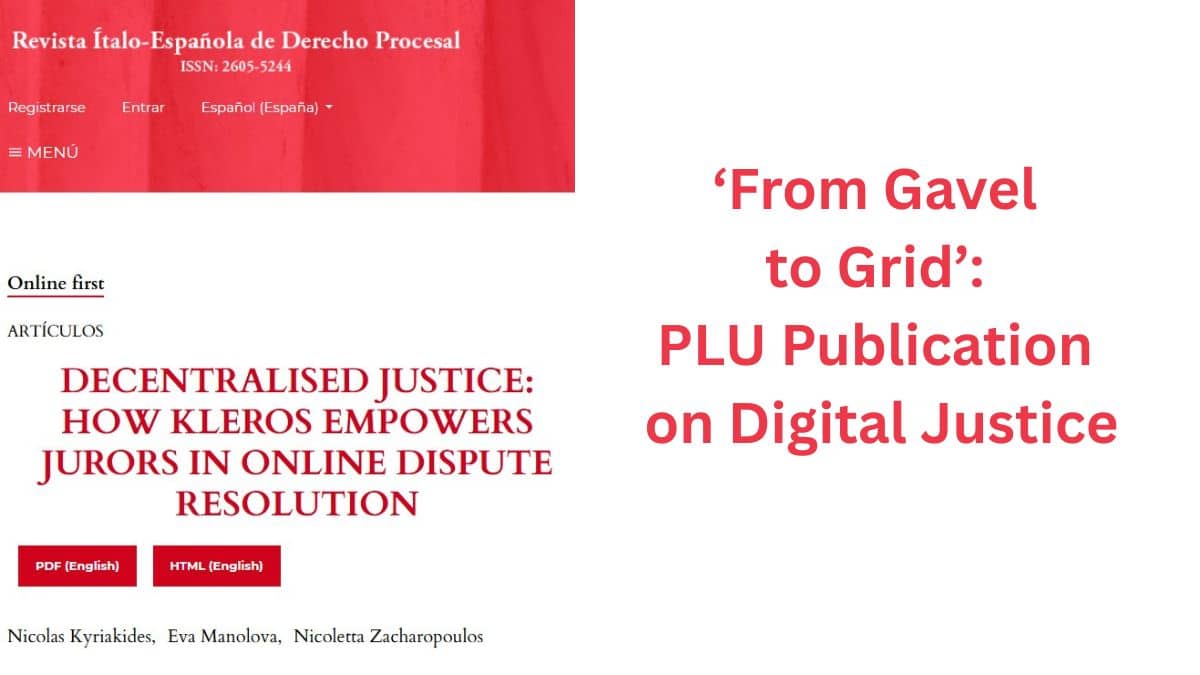
‘From Gavel to Grid’: PLU Publication on Digital Justice
The University of Nicosia’s Procedural Law Unit (PLU) has once again demonstrated its research excellence on the global stage with a successful submission to a competitive international Call for Papers titled ‘From Gavel to Grid: Reimagining Civil Justice in the Digital Era’. Hosted via EasyChair, this special issue of the Italian‑Spanish Journal of Procedural Law invited original scholarly contributions that explore the transformative impact of digital technologies, particularly artificial intelligence (AI), on civil justice systems worldwide.
Overview of the Call
The ‘From Gavel to Grid’ Call for Papers sought research that critically engages with the profound ways in which technological innovation is reshaping civil justice. Submissions were encouraged on topics including:
- the transformation of procedural norms through digital tools,
- the role of AI in judicial decision making,
- online dispute resolution mechanisms,
- ethical, legal and regulatory implications of technological integration, and
- comparative analyses of how jurisdictions govern tech‑enabled justice.
Central to the special issue’s mission was to foster rigorous interdisciplinary debate on ensuring equitable access to justice amid rapid technological change. By bridging legal theory, empirical research, and policy analysis, the issue aimed to highlight both opportunities and challenges in adopting AI and other digital systems in civil justice processes.
PLU Shortlisted and Published Paper
Among the entries to this competitive call, the Director of the Procedural Law Unit, Dr Nicolas Kyriakides, with work by Research Associates Eva Manolova and Nicoletta Zacharopoulos, were shortlisted and selected for full publication in the special issue. Their paper, titled ‘Decentralised Justice: How Kleros Empowers Jurors in Online Dispute Resolution’, was published in Revista Ítalo‑española de Derecho Procesal (Italian-Spanish Journal of Procedural Law) in April 2026.
In this contribution, the team examines decentralised justice systems such as Kleros, arguing that such platforms offer a complementary model to traditional judicial AI systems by combining partial automation with transparent, human‑centred adjudication. The paper highlights how decentralised mechanisms can enhance procedural fairness while mitigating risks of opacity, bias and legitimacy loss: key themes in the contemporary debate on digital justice.
The special issue ‘From Gavel to Grid: Reimagining Civil Justice in the Digital Era’ (Núm. 1, 2026) is available online.
View the published special issue.
Celebrating Global Engagement and Scholarly Impact
The inclusion of the PLU’s work in this special issue reflects both the international relevance of its research and its active engagement with emergent issues at the intersection of procedural law and technology. It underscores the research centre’s ongoing commitment to contribute to cutting‑edge discussions on access to justice, digital transformation, and ethical governance of AI in legal systems.
This achievement further positions the Procedural Law Unit as a leading voice in debates around digital civil justice and legal innovation, and sets a strong precedent for continued participation in global research networks that shape the future of law and technology.