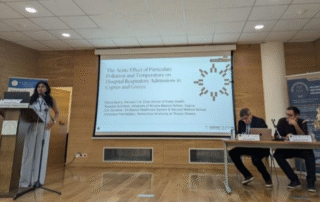


UNIC Medical School involved in Harvard-Cyprus Environmental Health projects

The symposium featured four keynote speakers and thirteen Harvard master’s students, who presented methodologies, emerging data, and trends in environmental health research across diverse geographical and socio-environmental settings.

2026-04-23T10:44:38+03:00February 9th, 2026|Featured Research, Medical School, News, Research, UNIC Health|

Article by UNIC’s Professor Drikakis and his team published by the American Institute of Physics (AIP), selected by Scilight for promotion

The study examines how large-scale urban greening can influence local airflow and heat transport in a dense metropolitan environment, with a focus on Athens, including the impact of the greening of Ellinikon on the local microclimate.

UNIC neurologist contributes to new guideline on asymptomatic hyperCKaemia

The guideline provides structured, evidence based recommendations to support clinicians and researchers in the assessment and management of asymptomatic/oligosymptomatic hyperCKemia, with the aim of improving consistency and clarity in day to day practice.

2026-04-23T10:40:38+03:00February 5th, 2026|Featured Research, Medical School, News, Research, UNIC Health|

UNIC study identifies key gene behind early embryonic cell development

The study, titled ‘NR6A1 is essential for neural crest cell specification, formation and survival’ explores the formation of neural crest cells (NCC), a migratory progenitor cell population unique to vertebrate embryos that helps in the development of many organs and tissues, including parts of the face, nerves, and heart.

2026-04-23T10:40:26+03:00February 3rd, 2026|Featured Research, Medical School, News, Research, UNIC Health|

Study warns climate change fuels tick-borne threats to Mediterranean livestock

A recent scientific review by Panagiotis Karanis, Professor of Anatomy at the UNIC Medical School, in collaboration with researchers from Greece and Turkey, highlights how climate change is creating compounded challenges for livestock systems in the Mediterranean.

2026-02-09T17:02:03+02:00January 8th, 2026|Featured, Featured Research, Medical School, News, UNIC Health|

Medical students contribute to depression treatment research

The two students worked with Clinical Associate Professor of Psychiatry at UNIC Medical School, George Mikellides, to document a case involving the combination of repetitive transcranial magnetic stimulation (rTMS) and ketamine therapy.

UNIC research reveals strong link between chronic stress and cancer risk

The researchers surveyed 1,318 participants from over 30 countries, collecting data on familial cancer history, stress factors, and self-reported cancer status. Using machine learning and causal modelling, they explored connections between chronic psychological stress and cancer occurrences.

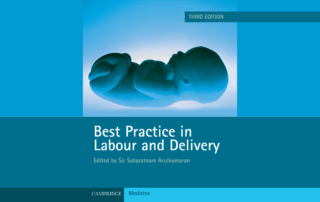
UNIC professor publishes leading textbook on safe childbirth

UNIC professor publishes leading textbook on safe childbirth The third edition of ‘Best Practice in Labour and Delivery’, edited by Sir Sabaratnam Arulkumaran, Professor of Obstetrics & Gynaecology at the University of Nicosia Medical [...]

2026-02-10T15:23:54+02:00December 5th, 2025|Featured Research, Medical School, Research, UNIC Health|

Medical School participates in a €400K Erasmus+ grant

The Medical School participates in a €400,000 Erasmus+ grant for the Virtual Realities in Medical Education (ViR-MEd) project. The project is led by Dr Achilleas Pavlou, with team members Professors Alexia Papageorgiou, Stelios Georgiades, and Dr Panagiota Andreou.

2026-02-10T15:22:45+02:00September 25th, 2024|Featured Research, Medical School, News, Research|

Weather Seasonality Can Help Predict Second Wave of Pandemic

University of Nicosia researchers Dbouk and Drikakis reach quintet of COVID-19 related research. According to their latest paper in Physics of Fluids, temperature, humidity, and wind are typically overlooked key epidemiological parameters

2022-12-16T11:14:23+02:00February 5th, 2021|COVID-19 Seasonality, Featured Research, News|

Air Purifiers may increase the spread of airborne viruses

University of Nicosia researchers Dbouk and Drikakis return with important input as relates to COVID-19 and confined spaces. According to their latest paper in Physics of Fluids, adding ventilation increases the rate at which potentially infected air can circulate in compact spaces.

2023-03-22T08:35:47+02:00February 5th, 2021|COVID-19 Confined Spaces, Featured Research, News|
Go to Top