

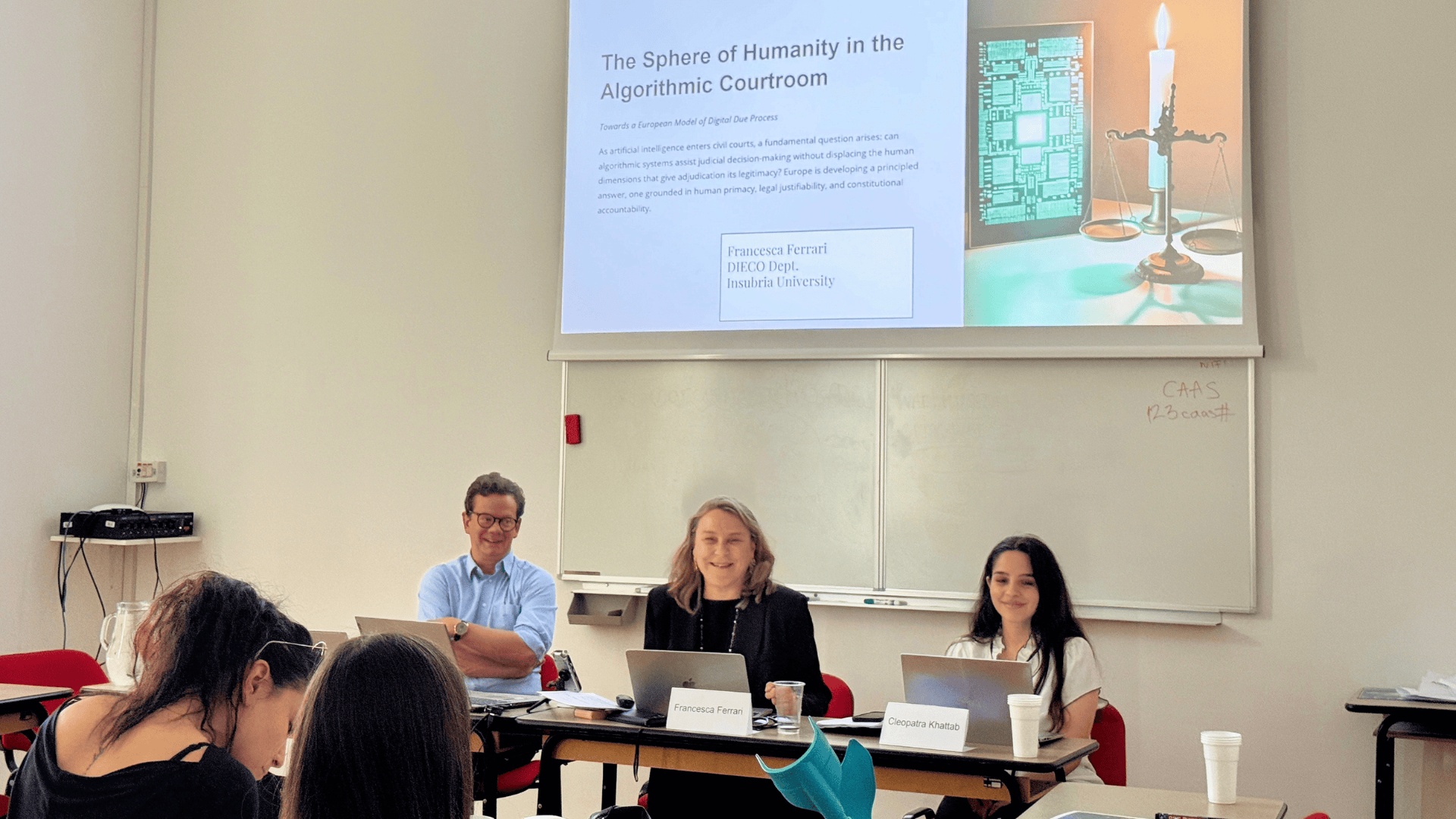
“From Fallible Minds to Formal Institutions”: PLU Presentation at the Dubrovnik Conference on Digital Justice
The Procedural Law Unit participated in the conference “Public and Private Justice: Dispute Resolution in Modern Societies”, held as part of “YEAR XX: Digital Transformation of Civil Justice – Improving or Dehumanizing Dispute Resolution?”, at the Inter-University Centre Dubrovnik on 25–29 May 2026.
The Unit was represented by its External Associate, Cleopatra Khattab, who delivered a presentation entitled “From Fallible Minds to Formal Institutions: Why Democracies Must Rethink Human Decision-Making”. The presentation was co-authored by Dr Nicolas Kyriakides, Cleopatra Khattab and Galateia Xenophontos.
The conference brought together academics, researchers and practitioners to discuss the challenges and opportunities arising from the digital transformation of civil justice. Discussions focused on the impact of emerging technologies on dispute resolution, procedural fairness, access to justice and the future of adjudication in modern societies.
The presentation examined public perceptions of trust in both human and AI-assisted judicial decision-making, drawing on comparative survey research conducted across multiple jurisdictions. It explored broader questions concerning impartiality, transparency, accountability and institutional legitimacy, highlighting how concerns regarding both human decision-makers and technological tools reflect a deeper challenge of maintaining public confidence in adjudicative systems.
The research argued that the debate should move beyond a simple comparison between human and artificial decision-making and instead focus on the institutional conditions necessary to ensure fairness, consistency, explainability and trust. The findings suggest that public confidence depends not only on who makes decisions, but on whether the decision-making framework itself is perceived as legitimate, transparent and accountable.
The presentation reflects the Procedural Law Unit’s ongoing research on civil justice, judicial legitimacy, digital transformation and the implications of emerging technologies for legal systems. It further contributes to current discussions on how courts and legal institutions can integrate technological innovation while preserving fundamental procedural guarantees and public trust.
Through its participation in the conference, the Procedural Law Unit contributed to an international and interdisciplinary dialogue on the future of civil justice and dispute resolution. The Unit extends its thanks to the organisers and participants for creating a valuable forum for academic exchange and discussion on the evolving relationship between technology, institutions and justice.