

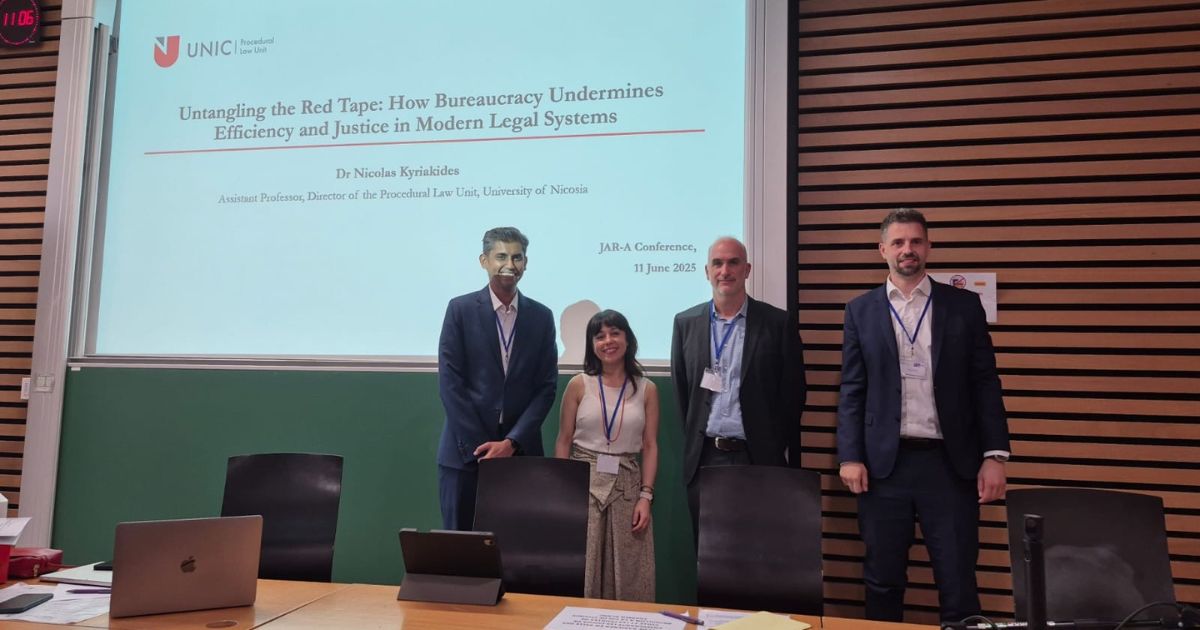

The Procedural Law Unit at the JAR 2025 conference in Limoges on reducing bureaucracy in justice
Dr Nicolas Kyriakides, Director of the Procedural Law Unit at the University of Nicosia, presented his latest research at the 2025 Justice Administration Research (JAR) Association conference “Judicial Systems in Transition: Reforms, Innovations and Justice”.
The event brought together leading experts and practitioners to discuss how judicial systems worldwide are evolving to ensure more equitable and efficient access to justice. Dr Kyriakides joined the panel “Access to Justice”, convened by Rosanna Amato, alongside Paul Prettitore, who examined the inequalities in the distribution of justice, and Mohammed Jalees, who shared insights from Singapore’s culture of access to justice initiatives.
In his presentation, titled “Untangling the Red Tape: How Bureaucracy Undermines Efficiency and Justice in Modern Legal Systems”, Dr Kyriakides unveiled new comparative research into how procedural complexity and bureaucratic systems obstruct access to justice. Drawing on survey data from Greece, Italy, Denmark and the Netherlands, the research highlights how excessive paperwork, rigid procedures and systemic delays disproportionately affect vulnerable groups and erode public confidence in legal institutions. By framing his findings within the broader theories of procedural justice and administrative rationalisation, Dr Kyriakides emphasised the pressing need to balance transparency and fairness with efficiency and accessibility.
The presentation sparked discussion among participants about innovative solutions, including digital justice tools, procedural reform and the potential role of artificial intelligence in reducing bureaucratic burdens. Dr Kyriakides concluded by calling for a strategic “untangling” of procedural red tape to restore public trust and ensure that judicial systems can deliver timely and equitable justice. His research contributes to the growing international discourse on how courts and policymakers can modernise legal systems to meet the demands of contemporary society while safeguarding the principles of fairness and due process.