

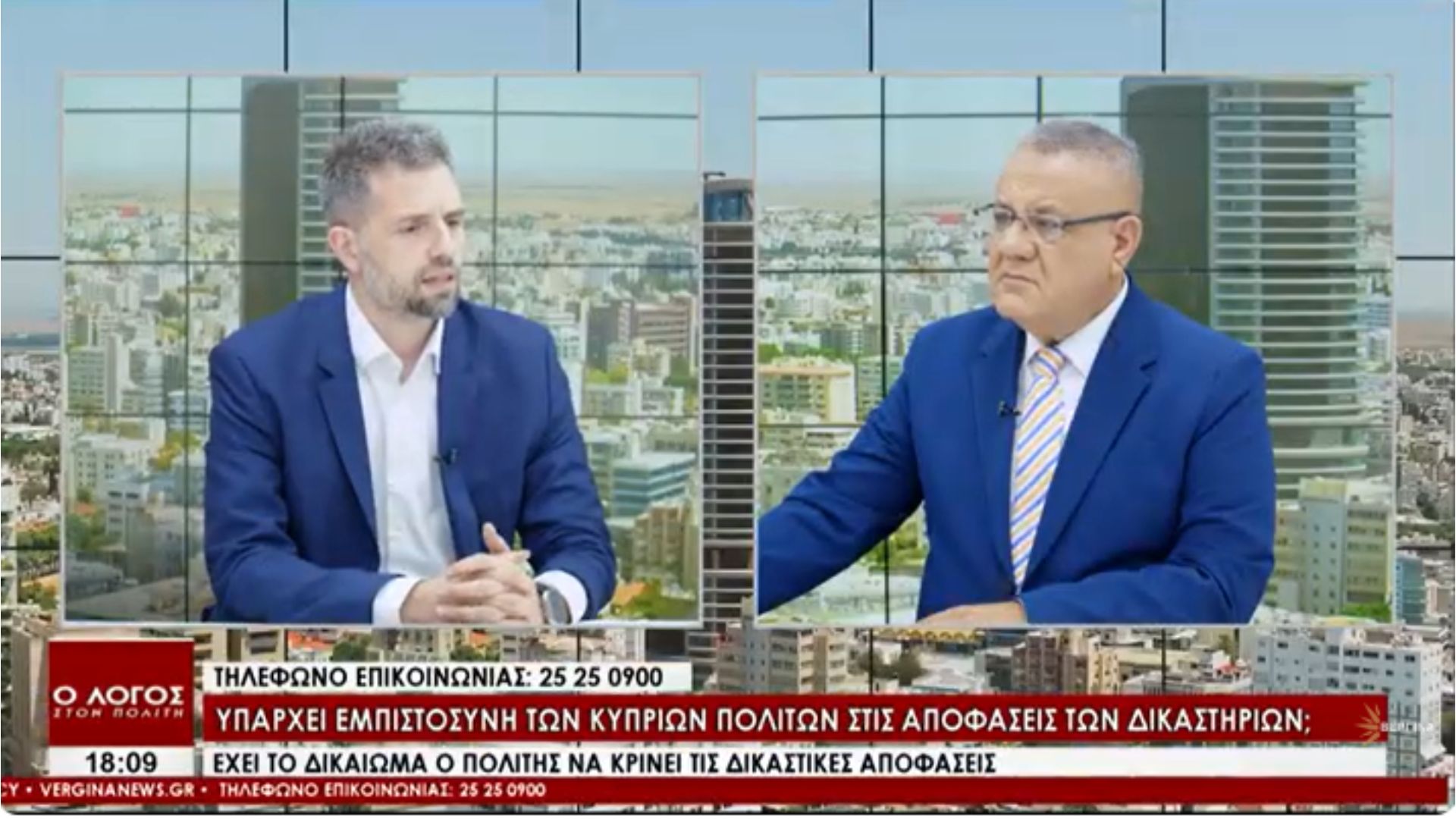
Rebuilding Trust in Cyprus’s Justice System: Insights from Dr Nicolas Kyriakides
The Director of the Procedural Law Unit at the University of Nicosia, Dr. Nicolas Kyriakides, recently appeared on Vergina TV Cyprus, where he discussed public confidence in the Cypriot justice system and the challenges facing the courts, with host Mikis Kasapis. The discussion focused on delays, quality of judicial decisions, transparency and the relationship between public expectations and institutional performance. The broadcast was interactive, with viewers calling in to share their experiences and concerns.
Speaking about the long-standing issue of judicial delays, Dr. Kyriakides noted that a decade ago Cyprus lagged significantly behind other European states, with civil disputes often requiring seven to ten years to be resolved, compared to an EU average of approximately three and a half years. He explained that this delay had serious implications not only for individuals but also for economic life and broader societal trust in institutions. He recognised that since then a number of reforms have been implemented, including the introduction of new Civil Procedure Rules, the recruitment of additional judges and a dedicated framework designed to deal with long-pending cases. According to recent figures referred to during the programme, around seventy per cent of cases filed before 31 December 2018 have now been completed, with roughly thirty per cent still pending. If this trajectory continues, Cyprus could reach a timeframe of around four years in the coming years, bringing it much closer to European averages.
At the same time, Dr. Kyriakides highlighted an important consequence of recent reforms: a noticeable drop in new case filings. While the aim of modern procedural rules is partly to encourage settlement before litigation, he cautioned that the reduction may also reflect citizens’ hesitation to turn to the courts, driven by diminished trust and concerns about litigation costs. Achieving the right balance, he said, requires a justice system that resolves disputes effectively while remaining accessible to the public.
The conversation also examined the perceived quality of judicial decision-making. Dr Kyriakides stressed that legal outcomes often involve nuanced assessments and are not always susceptible to straightforward measurement. Nonetheless, certain indicators do exist. One is the rate at which first-instance decisions are overturned on appeal. Another is the scrutiny that comes from external judicial bodies. In this context, he referred to several European Court of Human Rights decisions involving Cyprus. He highlighted that Strasbourg has, in recent years, issued judgments identifying shortcomings in areas such as the adequacy of investigations and aspects of judicial procedure. He mentioned, specifically, a case concerning a rape investigation in Ayia Napa (X v Cyprus), as well as the Koulias v Cyprus and Nicholas v Cyprus decisions, which addressed matters related to judicial composition. Such rulings, he emphasised, are not a condemnation of the system as a whole, but they serve as a reminder that institutional processes must constantly evolve and meet contemporary standards of fairness and transparency.
The live audience raised concerns about the role of lawyers and potential procedural abuses. Dr. Kyriakides acknowledged the perception that, when procedural space allows it, some practitioners may seek delays. However, he underlined that the new procedural framework sharply restricts opportunities for such tactics, provided judges enforce the rules consistently. He also pointed out that lawyers themselves often suffer as a result of frequent adjournments and scheduling uncertainty, particularly those travelling between districts and preparing for hearings that may not proceed.
Turning to solutions, Dr. Kyriakides emphasised the importance of transparent and robust criteria for judicial appointment, evaluation and promotion. He noted that strengthening initial judicial training, clarifying merit-based advancement and ensuring that procedures governing decision-making are open and predictable would significantly enhance trust. He also supported continued technological improvements, including the implementation of audio recording in courtrooms, which would increase accuracy and accountability in proceedings.
Throughout the interview, Dr. Kyriakides stressed that reform must be approached institutionally rather than through personal criticism. Public confidence is strengthened not by targeting individuals, but by improving the rules, systems and oversight mechanisms that guide the administration of justice. With sustained focus on efficiency, transparency and fairness, he expressed confidence that the Cypriot justice system can continue to improve and regain the trust of the public.
The full interview is available to watch here.