


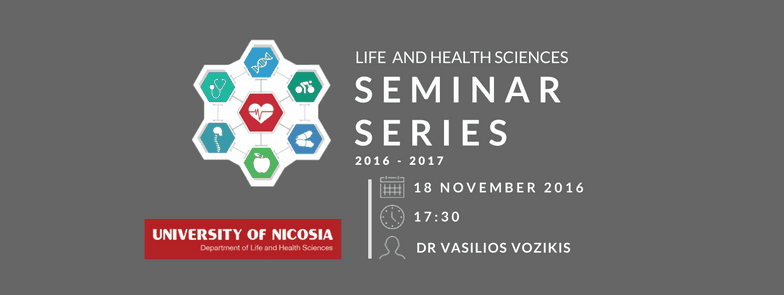
The Department of Life and Health Sciences invites you to the second talk in their new series of seminars open to the public, with Dr. Vasilios Vozikis on 18 November 2016, at 17:30 at the Jean Monnet Amphitheatre on Main Campus.
Date |
Time |
Venue |
|---|---|---|
| Friday, 18 November 2016 | 17:30 | Jean Monnet Amphitheatre (M -203, Millennium Building) |
About the Seminar:
Dr. Vozikis asks us to imagine a world without bees… Humans have been keeping honeybees for thousands of years. The oldest known honeybee specimen dates from 100 million years ago. The naturalist Jan Swammerdam (17th century) discovered that the king bee had ovaries and was, in fact, a queen. Scientist Rudolf Steiner predicted in 1923 that artificial cultivation of honeybees would have severe consequences on the bee population (within the next 100 years).
Mass deaths in the bee colonies, as it is observed the last few years, may mean disaster for farmers, as well as some of the consumer’s favorite foods.
He will also touch upon the interdisciplinary field of Food science, drawing on his extensive experience in government and industry.
About the Speaker:
Dr. Vasilios Vozikis is Head of Biochemistry – Residues Laboratory of the Ministry of Agriculture, Greece, charged with the detection of Drug Residues in food and animal feeds. He is also the Director of the Centre of Veterinary Institutes of Thessaloniki of the Ministry of Agricultural Development and Food, Greece.
Dr. Vozikis received his first degree in Veterinary Medicine from the Aristotelian University of Thessaloniki, Greece, an MSc in Food Science from King’s College London, UK, and an MPhil in Food Biochemistry from Surrey University, UK. He received his PhD from the Aristotelian University of Thessaloniki, in the field of Biochemistry – Toxicology, focusing on Drug Residues in Food.
For further information and/or queries, please contact Dr. Vicky Nicolaidou at [email protected] or on 22841676.