
AI Learning Centre
Best Practices for Using ChatGPT at the University of Nicosia
TELC has meticulously combined resources on using these new technologies, use the toggles below to find out more.

1. Introduction: The Capabilities Of Artificial Intelligence (AI) Technology
The media and educational institutions have recently focused on generative artificial intelligence (AI) tools. These tools can mimic, and in some cases outperform, human abilities to research, write, problem-solve, create art, create videos, and even “learn” and evolve. As a result, there is concern that generative AI tools/apps (such as ChatGPT, GPT-4, and DALL-E, among others) could be used to assist students in engaging in academic misconduct. Concerns about text-generating tools, in particular ChatGPT, have risen to the fore because of their ability to generate content (e.g., essays, programming code, maths problem solutions) that students could then submit for credit without their lecturer‘s knowledge or approval. Moreover, although AI detectors are also developing quickly, their accuracy cannot be fully guaranteed.
This document therefore aims to outline best practices for faculty and staff at the University of Nicosia when using ChatGPT. By following these guidelines, users can maximize the effectiveness and benefits of this AI tool.
1.1 What is ChatGPT
Text-generation systems, such as ChatGPT, operate on demand: when presented with an enquiry or a prompt from a user, they draw on vast databases of information to produce genuine and human-like replies rapidly. Although the generated content is not always correct and may lack depth, this sort of technology can compromise the institution’s academic integrity efforts.
OpenAI introduced ChatGPT (GPT stands for Generative, Pre-trained, Transformer) on November 30, 2022. It is a massive language model that was trained on a significant quantity of data to anticipate the proper next word in a phrase. ChatGPT is capable of performing a wide range of activities (e.g., answering questions, generating content, summarizing text, translating material, and so on) and engaging in a wide range of topics. Its replies are frequently clear and impressive, however, they need to be verified carefully. The current version is GPT-4; also, please note, however, the correct name is GPT-4, whereas ChatGPT is a chatbot that uses GPT-3.5. Bing Chat, for instance, now uses the more advanced GPT-4 model.
We can assume at some point (possibly) soon that future iterations of ChatGPT:
- will use a predetermined quantity of knowledge that is valid after September 2021;
- will be connected to the Internet and have a very wide range of easily accessible plugins (some plugins are already available see https://openai.com/blog/chatgpt-plugins );
- will provide higher quality information that is consistently accurate and consistently logical;
- will generate outputs that indicates traits of critical, in-depth thinking without repetitions;
- will reference sources without errors and seamlessly combine information from many sources;
- will be multimodal (create images, sound/music, speech, videos etc)
See YouTube Video on What is ChatGPT? OpenAI’s Chat GPT Explained (9 minutes)
1.2 How to install and use simple prompts in ChatGPT
- You can access ChatGPT by visiting chat.openai.com in your web browser and signing up for a free OpenAI account (see here or see below). After you’re logged in, you can begin using ChatGPT by clicking “New Chat” at the top-left corner of the page and typing a question or prompt. Alternatively, if you want to use Bing with ChatGPT, you can point your web browser (which should be Edge for the foreseeable future) to www.bing.com and type your question into the search box (read more here).
First, navigate to chat.openai.com in a web browser on your computer, smartphone, or tablet. You’ll be asked to “Log In” or “Sign Up.” You can sign up with an email address, Google account, or Microsoft account for free.
After you’re logged in, you can begin using ChatGPT. Use the text box at the bottom of the screen to type a prompt. This can be a question or a specific request. Press the paper airplane icon to submit.
ChatGPT will “type” out the response in real time. When it’s done, you can provide feedback with the thumbs up and down buttons.
Each prompt kicks off a conversation. You can enter follow-up prompts or change the subject entirely. It will remember what you’re talking about.

If you don’t think the response was good enough, you can simply ask it to try again.

You can also tell ChatGPT when it’s incorrect about something. (it was made to say something false about Tom Hanks.)
You can bookmark the chat.openai.com website to quickly come back to it in the future.
Please note that sometimes even GPT-4 may be slow or limit the number of questions you can ask to 25 or 50 per three hours (see below). We expect this issue will be resolved as OpenAI scales

When prompting:
- Be clear and specific
- Use iterative prompting
- Experiment with multiple prompts
- Stay within the token limit
- Break down complex topics
1.2.1 Some Conceptual Points to consider:
- Understand the capabilities and limitations of ChatGPT
- ChatGPT is a powerful language model, but it is not a human expert. It can provide assistance in generating content, answering questions, or facilitating brainstorming sessions.
- Use ChatGPT as a supplement, not a replacement. ChatGPT should therefore be used as an additional resource alongside human expertise and other sources of information.
- Always fact-check the information provided by ChatGPT and cross-reference with other reliable sources.
1.2.2 Best practices for prompts (some basic principles)
- Be clear and specific: Use iterative prompting: Experiment with multiple prompts: Stay within the token limit: Break down complex topics: Summarize and paraphrase: Ethical considerations and respect privacy and confidentiality: By understanding the capabilities and limitations of ChatGPT, using clear and specific prompts, and adhering to ethical guidelines, faculty and staff can effectively leverage this powerful AI tool in our University setting. Always use ChatGPT as a supplement to human expertise and remember to fact-check its responses. Remember: software is only as good as information it finds and ingests (remember the principle of GIGO: garbage in, garbage out), ChatGPT may well create prose that mimics structural bias and racism that is present in its source material.
- Use precise language and provide context when asking questions or requesting assistance from ChatGPT.
- Specify the desired format or type of response, such as a summary, list, or step-by-step instructions.
- If the initial response is not satisfactory, refine your prompt with additional information or clarify your request.
- If you’re not getting the desired response, try different ways of phrasing your prompt or breaking it down into simpler parts.
- Handling Topics with Large Prompts or Replies
- ChatGPT has a token limit (e.g., 4096 tokens for GPT-4) which includes both input and output tokens.
- Ensure your prompt and the desired response will fit within this limit. If necessary, shorten or simplify your prompt.
- If the topic exceeds the token limit, divide it into smaller, more manageable sections.
- Use a series of related prompts to explore each part of the topic individually.
- To keep the conversation within the token limit, summarize or paraphrase information when necessary.
- Encourage users to provide concise and relevant information when interacting with ChatGPT.
- Do not use ChatGPT to process sensitive or confidential information, such as student records, personal data, or unpublished research.
1.3 Bing and GTP-4
Bing has been turbocharged with an injection of OpenAI’s ChatGPT technology, transforming Microsoft’s search engine into something capable of carrying on a conversation. While you can access Bing from any browser, right now the only way to access the new Bing with ChatGPT functionality via a web browser is to open it in Microsoft’s Edge browser. It can also be used in the Bing app and the mobile app version of the Edge web browser. Even if you use those apps though, you still need to sign up for early access to the new Bing. The good news is that Microsoft appears to have made Bing with ChatGPT available to everyone but you still need to join the waitlist to get approved for access. You just now get approved immediately.
- To join the waitlist, check out this guide on how to get on the Bing ChatGPT waitlist, but below is a brief overview:

1. Open Microsoft Edge (the fastest way is to tap the Start button and type “Edge” then hit Enter) and navigate to www.bing.com/new.
2. Hit Join the waitlist.
3. Type in the email and password associated with your Microsoft account, if asked.

And that’s it! All that’s left to do now is wait. If you want to increase your odds of being granted access to Bing with ChatGPT, Microsoft recommends you do the following:
- Set Microsoft Edge as your default browser
- Download the Microsoft Edge app from the Microsoft Store

1.4 What are Large Language Models (LLMs)?
Large language models are advanced AI algorithms that can understand and generate human-like language. These models are typically based on deep learning techniques, such as neural networks, that allow them to analyse vast amounts of text data and learn patterns and relationships between words, phrases, and concepts. The most advanced language models, like GPT-4, have been trained on massive datasets of text, often using hundreds of billions (and likely trillions soon) of parameters. This extensive training allows them to generate highly realistic language output, such as natural-sounding conversations or well-written articles, and even perform tasks like language translation or summarisation. These models have many applications, such as in language processing and generation, chatbots, content generation, and more. However, they also pose significant ethical concerns, particularly in terms of data privacy, bias, and the potential for misuse.
1.5 What is OpenAI
What is OpenAI ( https://openai.com/ )?
OpenAI is an artificial intelligence research laboratory consisting of the for-profit corporation OpenAI LP and its parent company, the non-profit OpenAI Inc. It was founded in December 2015 by Tesla CEO Elon Musk, Sam Altman, Greg Brockman, Ilya Sutskever, John Schulman and Wojciech Zaremba. OpenAI’s mission is to ensure that artificial general intelligence (AGI) benefits all of humanity. They conduct research in various fields such as deep learning, natural language processing, robotics, and more. They have developed several AI models such as GPT-3 which can generate human-like text. GPT-4 is a new language model created by OpenAI that can generate text that is similar to human speech. It advances the technology used by ChatGPT, which is currently based on GPT-3.5. GPT-4 comprises machine learning algorithms that can generate natural language text based on context, and according to OpenAI, GPT-4 is a large multimodal model (accepting image and text inputs, emitting text outputs) that exhibits human-level performance on various professional and academic benchmarks.
1.6 Perplexity and Burstiness in AI and human writing: two important concepts
Burstiness and perplexity are two concepts used to describe and evaluate text generated by AI models like ChatGPT or human writers. They help us understand the patterns and complexities in the text. Burstiness refers to the frequency of rare words or phrases appearing in a text. In the context of AI and human writing, burstiness quantifies how often uncommon words are used. A text with high burstiness has a greater number of rare words or phrases, while a text with low burstiness uses more common words and phrases. Perplexity, on the other hand, is a measure of how well a language model predicts the next word in a sequence. It is an indication of the uncertainty of a model when generating text. In the context of AI and human writing, high perplexity means the text is more unpredictable and diverse, while low perplexity indicates a more predictable and repetitive text.
AI writing is different from human writing in terms of burstiness and perplexity in the following ways:
- AI-generated text may have lower burstiness than human writing because AI models are trained on large datasets and tend to use more common words and phrases. Human writers, however, may use rare words and phrases more often due to their creativity and individuality;
- AI-generated text may have lower perplexity than human writing because AI models are optimized to minimize perplexity during training. This means they tend to generate more predictable text. Human writers, with their complex thought processes and personal experiences, can produce more diverse and less predictable text.
Example of AI writing with low burstiness:
“The weather was warm and sunny. The park was filled with people enjoying the day. Children were playing on the playground, and families were having picnics.”
Example of AI writing with low perplexity:
“I like to eat apples. Apples are my favorite fruit. I eat apples every day because they are delicious and healthy.”
Example of human writing with higher burstiness:
“Amidst the verdant foliage, the arboreal whispers of the sylvan expanse enraptured the peregrine’s spirit.”
Example of human writing with higher perplexity:
“Life is like a box of chocolates; you never know what you’re going to get. The future is like an unwritten book, with each decision we make guiding the pen on the paper.”
Here is a good article on burstiness and Perplexity:
In summary, AI-generated text tends to have lower burstiness and perplexity compared to human writing, resulting in more predictable and common language patterns. Human writing, on the other hand, can showcase higher burstiness and perplexity, reflecting the diversity and creativity of human thought.
1.7 Understanding Tokens in ChatGPT
Definition of a token:
- In the context of ChatGPT, a token is a basic unit of text, which can be as short as one character or as long as one word.
- The AI model processes text by breaking it down into tokens, which can include words, punctuation marks, or special characters.
In the context of large language models (LLMs), a token refers to a single unit of text that the language model uses to understand and generate language. Tokens are typically individual words or punctuation marks, but they can also include other types of units, such as subwords or entire phrases.
For example, in the sentence “The cat sat on the mat.”, there are six tokens: “The”, “cat”, “sat”, “on”, “the”, and “mat”. Each token represents a discrete unit of meaning that the language model can analyse and use to generate new text.
Tokens are important in large language models because they allow the model to break down text into smaller, more manageable units that can be more easily analysed and processed. By using tokens, language models can identify patterns in language usage and generate new text that follows those patterns.
In practice, large language models may use various techniques to tokenize text, such as splitting words into subwords or using pre-defined vocabulary lists to map words to tokens. These techniques help to ensure that the language model can accurately represent and generate natural language text.
At the moment, ChatGPT has a maximum token capacity (e.g., 4096 tokens for GPT-4) that determines how much text it can process and generate in a single interaction.
- This limit applies to both the input (prompt) and output (response) combined.
Managing tokens effectively:
- To make the most of ChatGPT’s token capacity, users should strive to create clear and concise prompts.
- Keep in mind that lengthy or complex prompts may limit the space available for the model’s response.
- When approaching the token limit, consider breaking down the topic into smaller parts or summarizing the information to stay within the model’s capacity.
The approximate relationship of words to tokens in English?
- In English, the relationship between words and tokens is not fixed, as it depends on the specific text being processed. However, as a rough approximation, one can assume that on average, one word is equivalent to 1.25 tokens. This takes into account the presence of punctuation marks and special characters that contribute to the token count.
- Keep in mind that this is just an approximation, and the actual number of tokens for a given text may vary. In practice, the best way to determine the exact number of tokens for a specific text is by using tokenization tools provided by the language model’s API or other natural language processing libraries.
2. Academic Integrity, ChatGPT/AI writers and some ideas for AI-Enhanced Learning
There is a growing list of AI writers out there, however, ChatGPT appears to be the most versatile with new platforms with announcements being made nearly on a daily basis e.g. OpenAI connects ChatGPT to the internet. See here to read about The best AI chatbots: ChatGPT and other interesting alternatives to try in 2023 or read about the 26 Best AI Writing Software For 2023 (Best Picks by Demand Sage) here on 26 Best AI Writing Software For 2023 (Best Picks) (demandsage.com).
2.1 Concerns
A variety of issues are brought up by the capability to generate relatively high-quality content rapidly and efficiently. Faculty are worried about how ChatGPT will affect, among other things, the usefulness of homework, the integrity of take-home exams and essays, and the potential for AI-generated discussion post responses. Many academics fear that monitoring student work too rigorously for potential AI application may undermine the learning environment and the interactions with students.
- Plagiarism: If students use GPT or similar tools to generate written work, there is a risk that they may submit work that is not their own, or that they have not fully understood and can’t explain. This can lead to issues of academic dishonesty and plagiarism.
- Limited learning opportunities: If students use GPT or similar tools to complete assignments, they may miss out on the opportunity to practise and develop their own critical thinking skills.
- Bias: ChatGPT is trained on a dataset of human conversations, which may contain biases that are reflected in its responses. This could lead to unfair or prejudiced treatment of certain groups of students or researchers.
2.2 Introducing AI technologies to students and expectations of the institution
As a lecturer, expect students to be inquisitive about these tools and to need clear guidance on whether they are authorised to use them for academic work within your course. As a result, instructors are urged to engage students in an open conversation regarding artificial intelligence apps and how they interface with academic integrity.
When speaking with students, preferably at the beginning of the semester, inform them of the following institutional expectations:
- Any unauthorised use of ChatGPT (or other AI technologies) on exams is seen as a violation of academic integrity;
- Remind students of the Policy on Academic Honesty and provide examples of how unauthorised use of this technology can lead to violations of:
- Cheating if they use an AI tool to gain an unfair advantage on an academic evaluation when it has not been authorised by their lecturer.
- or plagiarism if they use images created by others, such as through the use of DALL-E or another image-generating tool when it has not been authorised by their lecturer.
- When giving assignment instructions, be extremely clear about your expectations. To assist prevent confusion, make sure these objectives are presented in a variety of methods, such as in Moodle, teaching guidelines, and in class.
- Teach information literacy through AI. Many students over-trust information they find on websites; use AI software to fuel a conversation about when to trust, when to verify, and when to use information found online.
- Discuss how various lecturers might have varied expectations for AI tools, and if it is authorised by one lecturer, this does not indicate it will be permitted by others.
You can also possibly utilise the arguments raised above to further examine the ethical implications of AI technology in your discipline, as well as any possible issues that may develop. Some leading conversation questions may be:
- What do you know about artificial intelligence apps?
- Have you used them before? How, if at all, have you done so?
- What were your observations?
- What are some ethical difficulties that might come from utilising these applications in your field/discipline?
- How can you utilise AI apps to help you study in an ethical manner?
Consider creating and prioritising an honour code in your class. Submitting AI-created work as one’s own is, fundamentally, dishonest. As professionals, we consider it among our top priorities to graduate individuals of character who can perform admirably in their chosen discipline, all of which requires a set of core beliefs rooted in honour. Make this chain of logic explicit to students (repeatedly if necessary) in an effort to convince them to adopt a similar alignment toward personal honesty. A class-specific honour code can aid this effort, particularly if invoked or attested to when submitting major assignments and tests.
Consider discussing the ethical and career implications of AI-writing with your students. Early in the semester (or at least when assigning a writing prompt), have a frank discussion with your students about the existence of AI writing. Point out to them the surface-level ethical problem with mis-representing their work if they choose to attempt it, as well as the deeper problem of “cheating themselves” by entering the workforce without adequate preparation for writing skills, a quality that employers highly prize.
Consider reducing course-related workload to disincentivise cheating. Many instances of student cheating, including the use of AI-writing, is borne out of desperation and a lack of time. Consider how realistic the workload you expect of students is.
2.3 Updating your course outline
You may consider adding a statement to your syllabus or even just consider your syllabus in light of AI tools. Below are some examples of statements you could consider adding:
- Assignments in this course are designed so that students are asked to connect course content, class conversations, and lived experience. It’s therefore harder for AI-based tools to effectively connect the dots between these sources of knowledge.
- If you have questions about what is permitted, please reach out to me.
- It is important to remember that ChatGPT and other AI tools are not a replacement for your own critical thinking and original ideas. The ultimate goal of this course and any tool used to submit work is to enhance your own learning and understanding, not to undermine it.
- As a college student, it is your responsibility to maintain the highest standards of academic integrity. This includes a) ensuring that all work submitted for grades is your own original work, and b) properly citing any sources that you use.
- Having AI write your paper constitutes plagiarism. If the source of the work is unclear, I will require you to meet with me to explain the ideas and your process.
- Consider AI-assisted assignments.
2.4 Rethinking assignments in the ChatGPT era
Writing at the university level should always be precise, and students should be able to demonstrate their thought process. If a machine has completed the entire task of writing a piece, the student has not been specific or has been unable to explain their work. Here are some ideas (non-mutually exclusive); please note, they are only ideas and need to be explored and even tweaked. Some may not work in your teaching context.
2.4.1 Ten ideas for designing assignments
- Consider designing assignments that ask students to connect course content, class conversations, other unusual/unique material and lived experience. It’s harder for AI-based tools to effectively connect the dots between these sources of knowledge. Also, consider dividing such newly designed assignments into shorter more focused ones. Students are less inclined to cheat when assignments are scaffolded into smaller bits, and they also produce better final products.
- Consider making Your Assignments Harder For AI Writers by adding specific prompts and personal experience prompts, see: Two Simple Things To Change In Your Assignments To Make It Harder For AI Writers: Specific Prompts And Personal Experience Prompts, TELC Portal (unic.ac.cy)
- Consider learning how ChatGPT would respond to your class assignments: Try out ChatGPT yourself to understand its capabilities and limitations.
- Consider assigning more personalised writing, the more personalised, the better. This approach may also help you get to know students’ writing in more detail so that you can recognize their style and tone.
- Consider writing in an authentic environment. While some students may lack experience with in-class writing (on paper), this high-touch method of collecting and grading writing offers the best chance to eliminate academic misconduct. In larger classes, grading may be kept more manageable by assigning shorter, but more frequent, in-class writing assignments. Furthermore, consider extending flipped learning for writing/creating class time.
- Consider assigning writing with heavy citations. The AI software is more likely than a student to use citations that you (let alone a student) might never think to use, making them appear suspicious. Moreover, the chosen citations might poorly reflect what you had in mind with your hyper-customized writing prompt.
- Consider re-envisioning writing as editing/revising. Assign students to create an AI essay with a given prompt, and then heavily edit the AI output using Track Changes and margin comments. Such an assignment refocuses the work of writing away from composition and toward revision, which may be more common in an AI-rich future workplace. ChatGPT is spectacular at providing summaries, but they lack details and specifics, which could be what the students are tasked to do. Other examples include better connecting examples to claims, and revising overall paragraph structure in service of a larger argument.
- Consider using authentic assignments requiring judgment and innovation. An authentic assignment is one that requires application of what students have learned to a new situation, and that demands judgment to determine what information and skills are relevant and how they should be used.
- Explore formats beyond traditional essays. In some cases, there may be other ways to communicate thinking, analysis, or evaluation without using a written essay. Examples might include interviews, asynchronous “face the camera” extemporaneous (rather than read) videos, mind maps, podcasts, vlogs, debates. Other examples of alternatives that require integration of many skills and types of knowledge:
- Poster (which could be presented to the class or a larger audience in a poster session)
- Portfolio to demonstrate improvement or evolution of work and thinking over time
- Powerpoint presentation
- Reflection by students on what they have learned from an experience
- Refine editing skills via grading. Assign students to create an AI essay and grade it, providing specific feedback justifying each of the scores on the rubric. This assignment might be paired with asking students to create their own essay responding to the same prompt.
2.4.2 Some ideas for the mode of assignments
- Consider doing group assignments see: Can Group assignments be a good idea to discourage cheating with ChatGPT? (I asked ChatGPT this question and liked its answer!)
- Consider re-envisioning writing as first and third stage human work, with AI performing the middle. Instead of asking students to generate the initials drafts (i.e., “writing as composition”), imagine the student work instead focusing on creating effective prompts for the AI [see section 1.2.2 Best practices for prompts (some basic principles)] as well editing the AI output; then challenge students to transform AI output into more creative output.
- Consider including peer review assignments can help mitigate the effect of AI-based tools on your course while also generating positive student engagement, boosting student learning, and positively impacting student retention. TELC provides training on Moodle Workshop.
2.4.3 Nine other general assignment-related pieces of advice
- Consider teaching through AI-based tools. Think about how using AI-based tools might facilitate students’ learning and prepare them to thoughtfully engage these tools in their personal and professional lives. How can AI-generated work help students think critically about digital literacy, information accuracy, and even what constitutes effective writing?
- Continue to reflect: What do we want students to get out of any given assignment? Where is the crux of critical thinking?
- Consider collecting at least one diagnostic of in-person writing to compare to submitted essays. A student whose formal essay writing style deviates significantly from their spontaneous, hand-written writing might warrant additional scrutiny.
- Double check AI-generated citations. AI software is known to “hallucinate” citations (essentially: invent plausible, but fake examples)
- Preview your writing prompt on the AI platform yourself. The type of prose produced by ChatGPT is remarkably cohesive, but the style can be recognized over time. Certain markers, like the flat topic sentences that begin most paragraphs, can help identify the prose as machine-generated. The rhetorical level of the prose can also be a marker-for many topics, the produced essay is superficial and can be characterized more as summary than analysis. It can also be helpful to know what your students might be seeing as output if they ask the AI a similar question, which can aid in detecting misconduct on student-submitted essays.
- Consider giving only closed-book exams (online). Assume that students can and will use the Internet and any available AI to assist them.
- Create grading rubrics for major assignments that account for correct AI use. Provide incentives for the behaviours and habits that are associated with strong learning. Give specifics about the assignment when asking the software to create a rubric in table format. Optionally, give it the desired sub-grades of the rubric.
- Focus on higher order thinking tasks in Bloom’s taxonomy (e.g., analysis/creation over recall): ChatGPT is best at summarizing from its training data and less good at applying knowledge to new areas.
- Read how GPT-4 suggests it should be cited: We asked ChatGPT ‘How do you cite ChatGPT?’ Here’s an example of how you might cite ChatGPT in APA format:
OpenAI. (2022). ChatGPT: A Generative Pre-trained Transformer Language Model (Version 3). Retrieved from https://chatgpt.openai.com/
2.5 Being realistic about AI detectors and when all else fails
There are many AI detectors out there and there is an array of AI detector by-passer sites eg Conch, Supercharging you with AI (getconch.ai) or GPT-Minus1 (gptminus1.com). This article presents two well-known AI detectors: GPT-2 Output Detector and GPTZero. However, as AI detectors will always be trying to play catch up with the latest iterations of AI writers, at best, they may help to raise suspicion levels only. At worst, their outputs may be incorrect and so cannot be relied upon. Additionally, the reliability of detectors has been questioned publicly, for instance, this article from the Guardian discusses how OpenAI’s Text Classifier tool correctly identified only 26% of AI-generated English content. Lecturers are also encouraged to become informed about the limitations and privacy concerns of these tools.
- When all else fails
Be on the lookout for AI-produced texts. Play around with the tool and get an idea of what kind of prose is produced to the questions you typically ask. Not only will you gain insights on how to better write your assignments, but you may get a sense of the “voice”, or lack of voice, of the tools. Some users of ChatGPT describe ChatGPT text as follows:
- It’s atypically correct in grammar, usage, and editing.
- It’s voiceless, correct and easy to read, but without any sense of a human person, fallible, uneven, passionate, awkward, present.
- It follows predictable formations: strong topic sentences at the top of paragraphs; summary sentences at the end of paragraphs; even treatment of topics that reads a bit like patterns: On the one hand, many people believe X is terrible; on the other hand, many people believe X is wonderful.”
3. Some examples of prompts and introducing advanced ChatGPT prompt engineering
AI is transforming how we study, conduct research, and work. It can help you 10x your productivity and income if used properly. There is simply no choice but to learn how to use ChatGPT and other AI tools if you want to stay competitive in this new world.
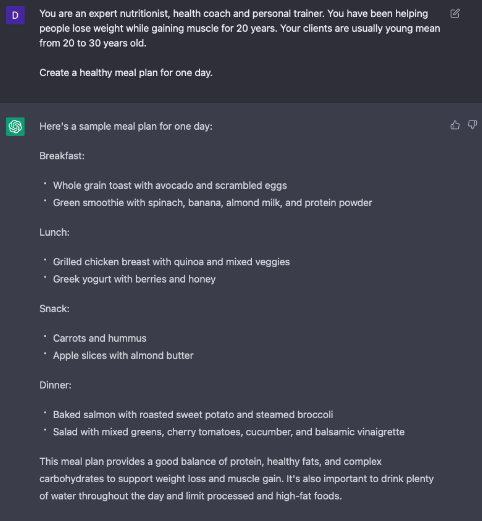
- Give ChatGPT an identity
For example: You want ChatGPT to write sales copy: “You are a professional copywriter. You have been providing copywriting services to businesses for 20 years. You specialize in writing copy for businesses in the finance sector.”

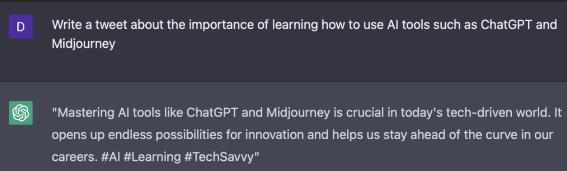
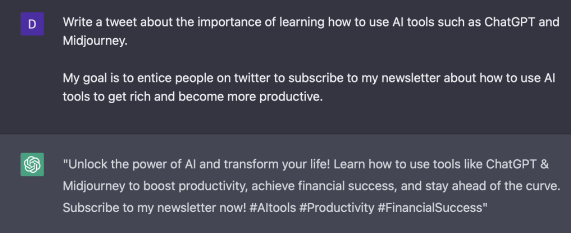
- Define your objective
For example: When we tell ChatGPT that the goal is to find subscribers for a newsletter, it makes the output much more specific to the benefits of learning how to use ChatGPT.
- Add constraints to your prompt
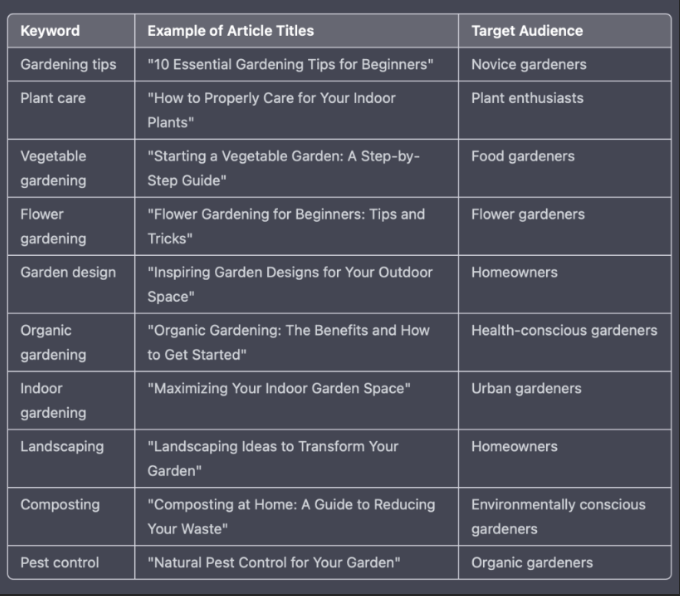
You can guide ChatGPT’s output by providing more details about what its answer should or should not be. Constraints help ChatGPT to understand what you are looking for and avoid irrelevant outputs. Here are some examples: Specify the length of the response: “Generate a 200-word summary of this news article.” Or Specify the format of the response: “Generate a table of keywords for a blog relating to gardening. Include “Example of article titles” and “target audience” as columns.”
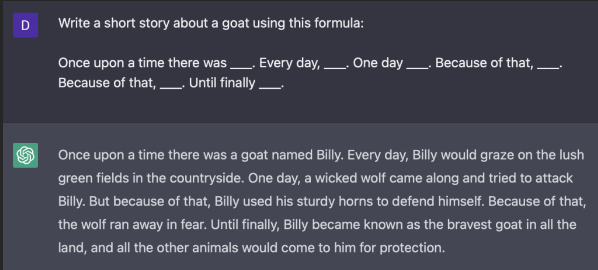
- Give ChatGPT a structure to follow
In copywriting and storytelling, there are tricks of the trade that all writers use to create persuasive and/or engaging content. Take advantage of this by asking ChatGPT to use these proven methods when completing a task.
- Refine the output through conversation
The beauty of ChatGPT is that it remembers the whole conversation within each chat. You can ask follow-up questions to dial down into a specific answer.Here are a bunch of useful follow-up prompts you can use to refine your ChatGPT answers:
Format this answer as a table
Write this from the perspective of [example here]
Explain this like I’m 5 years old
Add some sarcastic humor to this
Summarize this into a tweet (280 characters or less)
Put this into an actionable list
Forget everything we talked about before
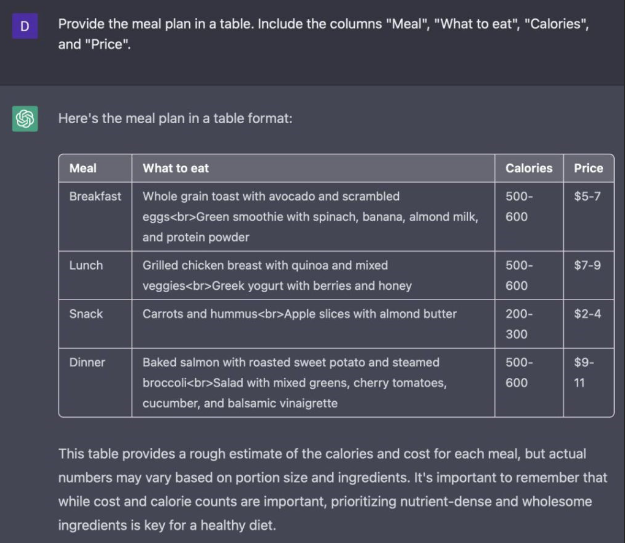

The five examples above were taken from here
Here are 10 simple prompt types (generated by GPT-4) that could be useful in a university context:
- Information retrieval: “What are the key principles of effective classroom management?”
- Summarizing content: “Please provide a summary of John Dewey’s philosophy of education.”
- Brainstorming ideas: “Suggest five potential research topics related to the use of technology in education.”
- Explanation requests: “Explain the concept of constructivism in educational psychology and its implications for teaching.”
- Comparative analysis: “Compare and contrast the advantages and disadvantages of online learning versus traditional classroom learning.”
- Developing lesson plans: “Outline a lesson plan for introducing the concept of photosynthesis to high school biology students.”
- Formulating exam questions: “Create three multiple-choice questions based on the principles of operant conditioning in psychology.”
- Providing examples: “Give three examples of how differentiated instruction can be implemented in a mathematics classroom.”
- Writing assistance: “Please help me draft an introduction paragraph for a research paper on the impact of artificial intelligence in the field of education.”
- Reflective prompts: “Discuss the role of critical thinking in higher education and its importance in preparing students for their future careers.”
Here are 5 examples (generated by GPT-4) of detailed prompts to be used in research brainstorming:
- “Generate a list of five potential research topics examining the impact of gamification on student motivation and engagement in higher education, with each topic focusing on a specific aspect of gamification, such as game mechanics, reward systems, or collaborative learning.”
- “Propose five research questions exploring the effects of remote learning on student mental health during the COVID-19 pandemic, with each question addressing different dimensions, such as social isolation, academic stress, or coping strategies.”
- “Suggest five research ideas investigating the role of virtual reality (VR) in enhancing the learning experience for students with disabilities, with a focus on specific areas like sensory impairment, mobility challenges, or cognitive limitations.”
- “Brainstorm five research topics related to the integration of artificial intelligence in personalized learning systems, considering aspects such as adaptive content delivery, learning analytics, or student-teacher interaction.”
- “Provide five potential research subjects examining the influence of interdisciplinary approaches on problem-solving skills and creativity among university students, with an emphasis on collaboration between different fields, such as science, arts, and humanities.”
Some resources on advanced prompting:
- Advanced Chat GPT Prompt Engineering [Reddit]
- How To Use ChatGPT: Advanced Prompt Engineering [article]
- Advanced ChatGPT Prompt Engineering
- Advanced Prompt Engineering short course
- Complete ChatGPT Tutorial, [Become A Power User in 30 Minutes]
- The Art of Prompt Engineering with chatGPT: A Hands-On Guide [Book]
- Here is an example of advanced prompt engineering. The human-ChatGPT interaction is fascinating and very productive 20230322, Initial Foods, Research Project, ChatGPT.docx
- writeGPT, ChatGPT Prompt Engineer Assistant [app]
- Master Prompt Engineering with ChatGPT | Udemy [course]
- 100 Prompts for Teachers To Use With ChatGPT
4. Other Links
- AI Articles on ChatGPT and Education (padlet.com)
- Bailey, J. (2022, December 7). Why Teachers Are Worried About AI
- D’Agostino, S. (2023, January 31). Designing Assignments in the ChatGPT Era
- Eaton, S. and Anselmo, L. (2023, January). Teaching and Learning with Artificial Intelligence Apps
- McClennen, N. & Poth, R. Education is about to radically change: AI for the masses
- McKnight, L. (2022, October 14). Eight ways to engage with AI writers in higher education
- McVey, C. (2022, December 05). POV: Artificial Intelligence Is Changing Writing at the University. Let’s Embrace It
- Mollick, E.R. & Mollick, L. (2022). New Modes of Learning Enabled by AI Chatbots: Three Methods and Assignments
- Prochaska, E. (2023, January 23). Embrace the Bot: Designing Writing Assignments in the Face of AI
- Schulten, K. (2023, January 23). Lesson Plan: Teaching and Learning in the Era of ChatGPT
- Webb, M. (2022, August 04). What’s next for AI in higher education?
General Information about AI Technology and Education
- Alby, C. (n.d.). ChatGPT: Understanding the new landscape and short-term solutions
- Alby, C. (2023, January 7). Can ChatGPT be a blessing?
- Ditch that Textbook (2002, December 17). ChatGPT, Chatbots and Artificial Intelligence in Education
- Kovanovic, K. (2022, December 15). The dawn of AI has come, and its implications for education couldn’t be more significant
- Morrison, R. (2022, November 16). How to Identify AI Generated Text
- Schulten, K. (2023, January 24). How Should Schools Respond to ChatGPT? (Student Opinion)
This resource has referred to AI good practice from a number of universities eg University of Central Florida, University of Washington, Montclair State University, Eastern Washington University, Salisbury University, Washington University in St Louis, Georgetown University among others.
Also, please note, to keep up to date on this quickly changing area, we encourage faculty and staff to subscribe to the Technology Enhanced Learning Centre AI blog page ( https://www.unic.ac.cy/telblog/artificial-intelligence/). The new AI-Enhanced Learning page is being launched because the AI space is literally changing on an hourly/daily basis, and there’s so much that needs to be mentioned. WordPress posts will be sorted according to date and most popular post. However, the three key aims of this new faculty and staff AI page are: (1) to keep users up to date on this quickly changing space; (2) to provide useful advice on which technologies might really be useful [ie and not just hyped]; (3) to explain how to use such technologies effectively. Drawing on this AI page, relevant faculty and staff AI training sessions will therefore be based on what is deemed to be useful and up to date.