
This report details the architecture and functionality of an automated workflow designed by the AI Learning Centre to collect foreign-affairs coverage from 26 newspapers and news sites across Greece, Turkey, Cyprus and the United Kingdom, grade it, match the same story across languages, and deliver a single weekly briefing in English.
The Power of an Agentic Platform
Reading the press of one country is a job. Reading the press of four, in three languages, every week, is not realistic without help. Our solution uses an Agentic Platform: a visual system that acts as a "digital nervous system" for the whole process. It connects the news feeds, a web scraper, AI reasoning models, a text-embedding service and email delivery into one automated pipeline. Each step is a visible, editable block, so the logic of the briefing can be inspected, tuned and improved without rewriting code from scratch.
The Use Case: One Region, Many Narratives
The Eastern Mediterranean is a region where the same event is rarely told the same way twice. A statement by a Greek minister, a move in the Cyprus problem, a new energy agreement or a diplomatic meeting involving Turkey will appear in Athens, Ankara and Nicosia on the same day, in different languages, with different emphasis and often a different headline.
For students and researchers of international relations, media and regional politics, this is exactly where the interesting material lies. But it is also where the work is hardest:
- Language. The most relevant coverage is in Greek and Turkish, and a reader who understands only one of them sees only one side.
- Volume. Dozens of outlets publish hundreds of items a day, and most of them are not foreign affairs: sport, entertainment, crime and local news make up the bulk.
- Repetition. The same event is reported by many outlets, so a simple feed reader fills up with near-duplicates.
The objective was to design a system that reads all of this for us, keeps only the foreign-affairs stories that matter, recognises when different outlets are reporting the same event, and presents the result as one short, readable weekly edition in English.
The Automated Workflow Solution and Its Benefits
Key benefits:
- Time Savings: Replaces hours of browsing across dozens of sites in three languages with one weekly email.
- A Wider View: Places Greek, Turkish, Cypriot and British outlets in the same briefing, so a reader sees how the region reports itself and how outsiders see it.
- Signal Over Noise: Leverages AI to grade every item and discard sport, entertainment, opinion, crime and purely domestic news before anything reaches the reader.
- Cross-Language Deduplication: Recognises that a Greek article and a Turkish article are about the same event, and shows them as one story with links to every outlet that covered it.
- Easy to Extend: The list of sources is kept in an editable table. Adding an outlet, or switching one off, takes one row and no change to the workflow.
- Consistency: Runs on a reliable automated schedule, delivering a dependable briefing every week without human intervention.
Workflow Process Overview
The workflow operates as an autonomous intelligence agent. It is triggered every Friday at 7:00 AM (Athens time) and completes in a few minutes. It looks back over the past seven days of coverage and delivers an edition of up to 20 stories, shown newest first, in two places: as a newspaper-style email and as a page in the AILC Workflow Library.
1. Multi-Source Collection
The process begins with a curated list of 26 outlets, read from an editable data table. The outlets are organised into groups so that the briefing can tell whose press is speaking:
- Greece: in.gr, To Vima, Ta Nea, Efsyn, Kathimerini, Proto Thema and SKAI.
- Turkey: Hürriyet, Cumhuriyet, Habertürk, CNN Türk, Yeni Şafak, A Haber, Sözcü, TRT Haber and Daily Sabah.
- Cyprus: Philenews, Politis, Cyprus Mail, Havadis, Yenidüzen and Gündem Kıbrıs.
- United Kingdom (outside reference): The Guardian, BBC News, The Independent and i news. These outlets can join a story and appear next to the regional press, but they do not count as one of the sides.
Each feed is read independently, so if one outlet is temporarily unavailable the rest of the run is unaffected. The workflow keeps only items from the past seven days, removes duplicates and drops obvious sport and entertainment categories before any AI is involved.
2. Grade First, Read Later
Instead of summarising everything and filtering afterwards, the workflow grades first. Every remaining item is passed, in batches, to an AI agent, using only the headline, the excerpt and the category of the article. The AI agent does three jobs at once:
- decides whether the item is foreign affairs at all (any international event or relation counts, including the Cyprus problem, relations between the two communities in Cyprus, Greece-Turkey relations and EU-Turkey relations);
- writes an English version of the headline, whatever the original language;
- scores the item on a 100-point framework.
How the Score Is Calculated
The AI assigns up to 90 points across four criteria, and the workflow adds up to 10 more by counting how many countries' press covered the same event:
- Stakes for the Region (0-30): How directly does the event concern Cyprus, Greece-Turkey relations or the wider Eastern Mediterranean?
- Something New (0-25): Is this a new development, rather than a repeat or a reaction to one?
- Real-World Impact (0-20): Does it change something on the ground: a decision, an agreement, a vote, a deployment?
- On the Record (0-15): Is it a documented fact or official statement, rather than speculation?
- Covered Across Borders (0-10): Added by the workflow, not the AI: 5 points when outlets from two countries report the event, 8 for three countries and 10 for four or more. When an event is covered on both sides of a border, it matters more.
3. Matching the Same Story Across Languages
This is the step that makes the briefing a "mirror". The English headline of every foreign-affairs item scoring 40 or more is converted by an embedding model into a numerical representation of its meaning. Items whose meaning is close enough, measured by cosine similarity, are grouped as candidates for the same story. Because the comparison is made on the English headlines, a Greek and a Turkish article about the same meeting can be matched even though they share no words.
A second check then removes the remaining doubt. An AI agent reads the headlines of the grouped stories and joins them only when they report the very same event, by the same people, on the same occasion. Analysis pieces, comments, reactions from other officials and later follow-ups on the same topic are kept apart. The instruction to the AI agent is deliberately cautious: when unsure, keep the stories separate, because a missed merge is better than a wrong one.
Each merged story keeps one lead item and a list of every other outlet that covered it, which later becomes a "Covered by" row in the briefing.
4. Full-Text Re-Check
A headline can flatter or mislead, so the best-scoring candidates are checked again against the real article. A web scraper fetches the full text of the lead article of each of the top 30 stories, and the AI agent re-grades each one on what the article actually says. Stories that no longer meet the quality bar are dropped.
5. Balanced Selection
Before the edition is assembled, the workflow chooses a lead item for each story. The highest-scoring item normally leads, but if an English-language outlet is close behind, it leads instead, so that "Read source" opens an article the reader can understand.
The best 20 stories that remain are sorted newest first.
6. English Summaries
For each selected story, the AI agent writes a short English headline and summary from the start of the fetched article.
7. Delivery
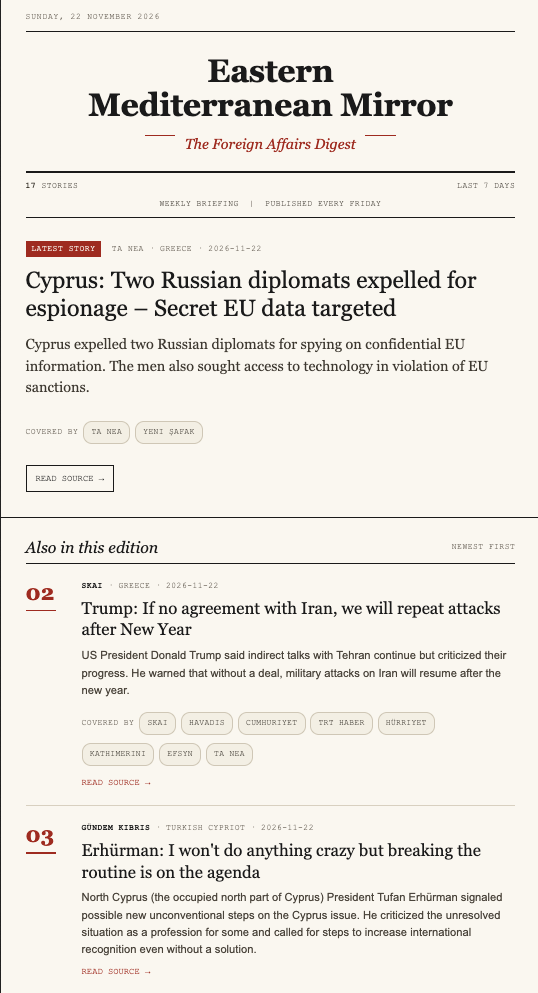
The final stage builds the briefing as a newspaper-style HTML email, sent through Microsoft Outlook, and publishes the same layout as a page in the AILC Workflow Library. The briefing is made of:
- a lead story, followed by an "Also in this edition" list;
- an English headline and short summary for every story;
- a row of "Covered by" links, one per outlet, each pointing to the original article in its original language;
- a note at the bottom explaining that the story selection, English headlines and summaries are produced with AI, may contain errors or omissions, and should be double-checked against the original sources.
The End Result
Every Friday, a reader receives one briefing instead of 26 websites. They can see which foreign-affairs events mattered most this week for the Eastern Mediterranean, which ones were reported across borders, and which outlets covered each of them, and they can open the original Greek, Turkish or English article in one click. For students and researchers at the AI Learning Centre, it turns a multilingual media landscape into something that can be read over a coffee.
The latest edition can be read in the AILC Workflow Library: https://workflowlab24.com/report/d49f3c8304723057a85abc582a94115ed4f52e7040eb0090/
Below is an example of the briefing as delivered to the end user: