

Excess all-cause mortality and COVID-19-related mortality: a temporal analysis in 22 countries, from January until August 2020
Since the earliest weeks following the emergence of SARS-CoV-2, it has been a challenge to understand the impact of the pandemic on mortality. COVID-19 death counts do not account for limited testing, upended healthcare systems, and deaths stemming from restriction measures. In short, countries worldwide are lacking an accurate picture of the direct and indirect mortality burden from COVID-19.
UNIC and research partners took note of this problem and devised the sort of global-scale project needed to address it. They launched the COVID-19 Mortality (C-MOR) Consortium focused on measuring excess mortality, which has grown to include 58 institutions across 6 continents and 52 countries.
Consortium partners in 22 of these countries were able to navigate through shared challenges of collecting and analysing five years of mortality data. Their hard work and collaboration paid off with a truly global dataset focused on excess mortality from the inception of the pandemic through to August 2020.
This work was published this week in the International Journal of Epidemiology by the Oxford University Press. The results represent one of the largest and most expansive studies of mortality from the pandemic that predominantly utilized national and primary sources, as opposed to publicly available datasets.

Figure 1
Observed 2020 mortality rate vs 2015-2019 average mortality rate (per 100 000 population) and stringency index (SI, %) by sex for countries providing weekly data (solid vertical line indicates the start of the reported COVID-19 deaths)
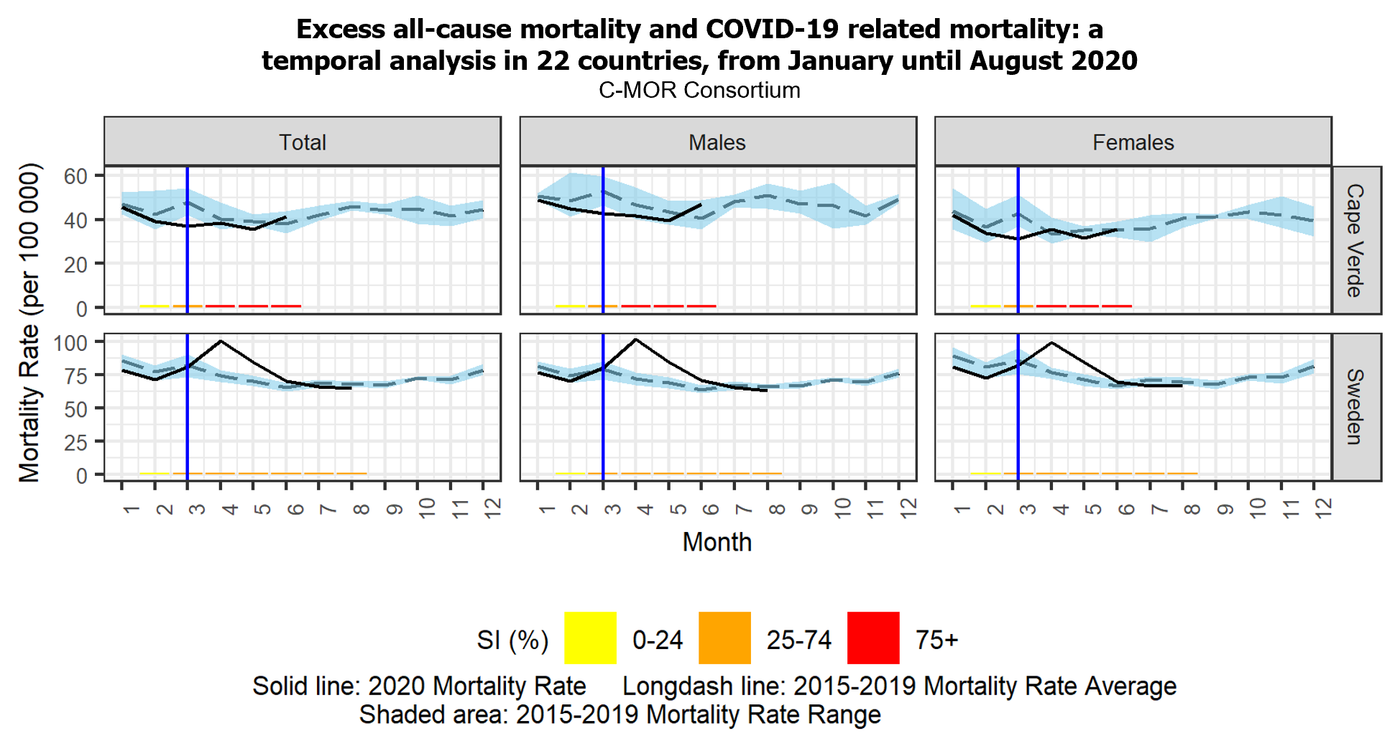
Figure 2
Observed 2020 mortality rate vs 2015-2019 average mortality rate (per 100 000 population) and stringency index (SI, %) for total population and by sex for countries providing monthly data (solid vertical line indicates the start of the reported COVID-19 deaths)
What Does This Mean?
Researchers with on-the-ground experience were able to collect the data for each of their respective countries and, thereafter, assess all-cause deaths during the pandemic along with all-cause deaths during the same period in previous years. As such, the Consortium was able to more accurately measure how the pandemic affected mortality in countries across the globe.
- As emerging and re-emerging infectious diseases become more common, our results provide valuable lessons on the impact epidemics can have on populations and also offer insight on what can be done to mitigate this impact.
- As we face this politicized pandemic, the consortium is actively collecting accurate and timely surveillance data. We will not only continue to monitor excess deaths but will also begin to study the morbidity burden from COVID-19. These analyses will help us to better understand and minimize the multi-dimensional health effects of the virus.
While the valuable lessons in this study make their way to policy-makers and healthcare professionals, the Consortium remains hard at work to aid in the response to this pandemic and future ones.
Press Materials
The University of Nicosia (UNIC)