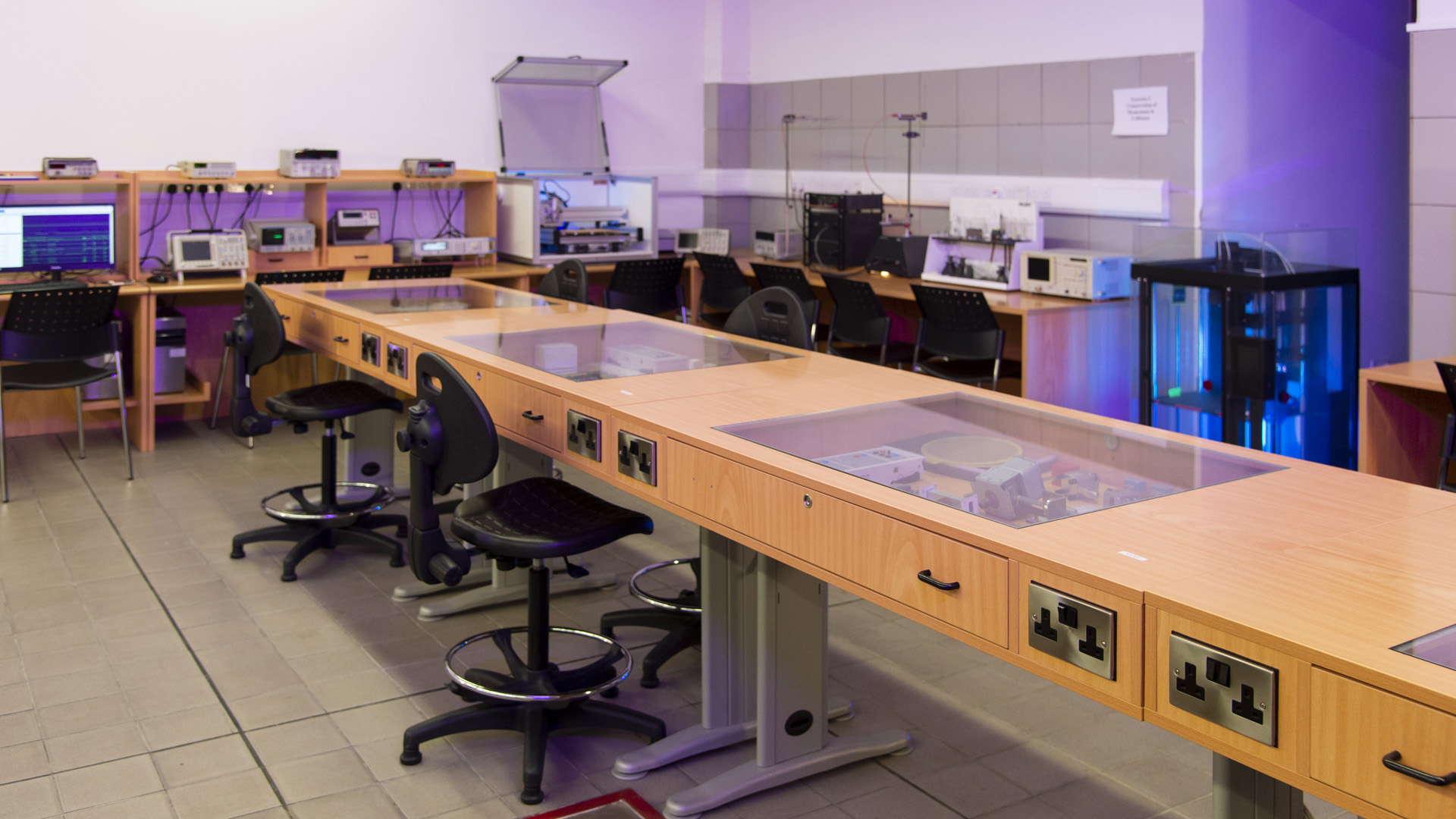
The Radio-Communications Laboratory is located at the Research & Technology Building. It is equipped with state of the art equipment and systems which serve both the educational and research needs of the students as well as the research needs of faculty.
The laboratory is divided into three sections, namely:
- Microwaves and Antennas section
- Prototyping
- Physics
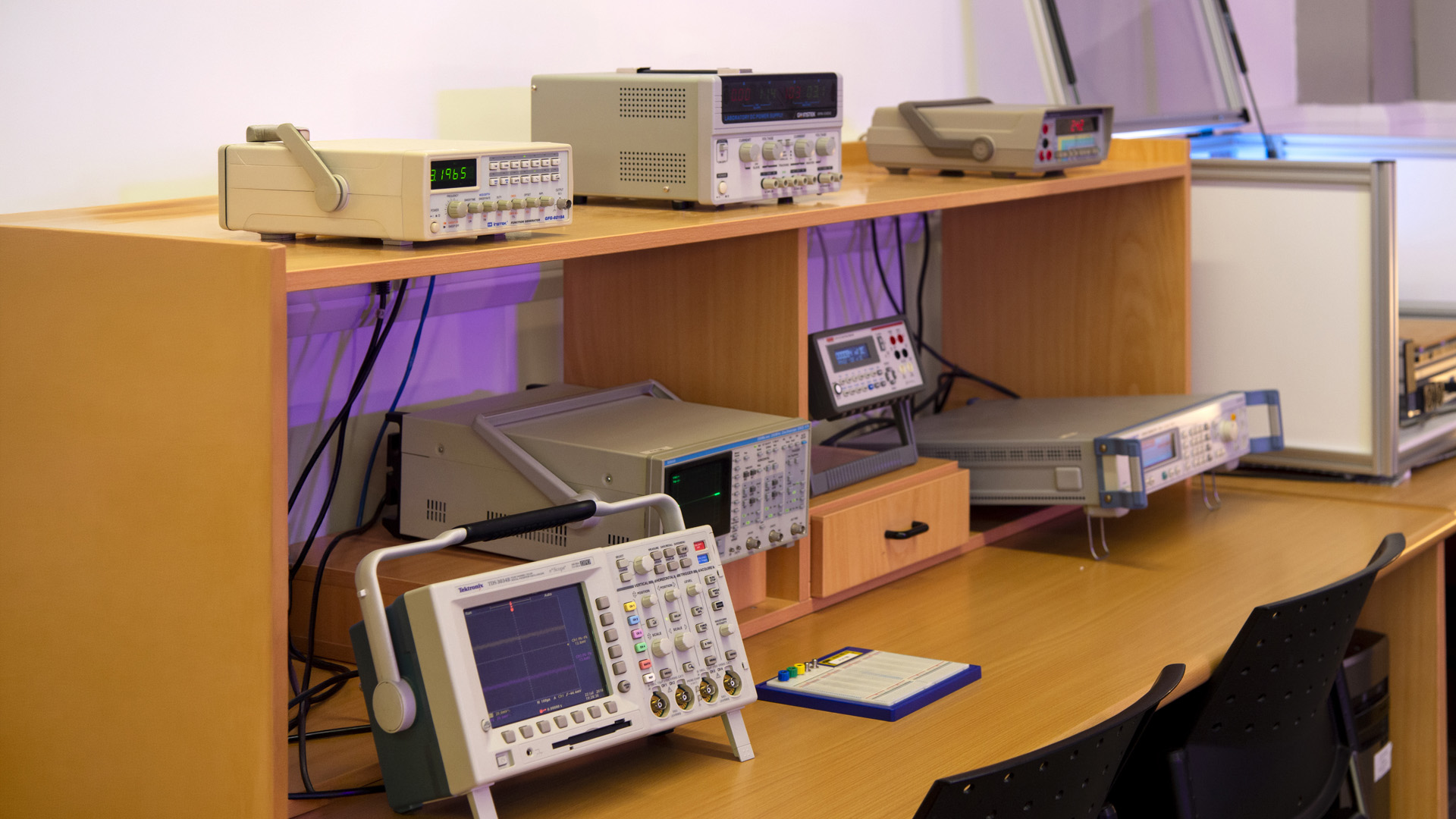
The Microwaves and Antennas section is equipped with a comprehensive range of advanced instruments and components for the design, analysis, and measurement of microwave circuits and antenna systems. Key equipment includes a handheld spectrum analyzer and a high-precision vector network analyzer capable of measuring S-parameters up to 6 GHz, supporting accurate characterization of RF components and networks. An antenna measurement system enables the evaluation of radiation patterns and gain for in-house antenna designs, while a high-frequency signal generator provides both continuous-wave and modulated signals for RF testing and communication experiments. Specialized instruments are also available for measuring electromagnetic fields and interference at low frequencies.
In addition, the section includes an extensive collection of microwave and RF components such as waveguides, antennas of various types, oscillators, couplers, modulators, transmission line elements, and related accessories. These resources allow students and researchers to perform a wide range of experiments in electromagnetics, antenna design, and microwave engineering. The facilities fully support the laboratory requirements of related courses, as well as final-year projects, postgraduate studies, and experimental research activities carried out by both students and faculty.
The Prototyping section supports the imminent needs of engineering faculty and students who want to fabricate a device or component either for their final-year project, thesis, or research topic. This particular laboratory division houses an accurate CNC machine, which is used for the fabrication of PCB boards and interconnect circuits. This machine is driven by a sophisticated software which converts Gerber files to a PCB drilling and routing layout. Different types of bits are used for copper etching and drilling. Students and faculty members of the Department are often using this CNC machine to develop their circuit boards without the need of chemical etching. In this lab, however, there exist a chemical etching facility as well, including UV exposure units (different wattage), an etching tank, liquid developer, ferric chloride etchant, photoresist, different types of substrates (including microwave substrates for RF circuits), dry film laminator machine, soldering irons, board cutters, drill machines, temperature-controlled oven, and more. This set of prototyping equipment is used for the completion of student projects and MSc theses, as well as for the development of scientific research.
The Physics Section of the Radio-Communications Laboratory is a well-equipped facility designed to support hands-on learning and the experimental investigation of fundamental physical principles.
A wide range of digital sensors and measurement tools enables precise, real-time analysis of physical phenomena. These systems allow students to explore key topics in classical mechanics, electricity and magnetism, waves, optics, and thermal physics through interactive experiments that emphasize quantitative analysis and scientific reasoning.
In addition, the laboratory is equipped with specialized small-scale setups for renewable energy studies, including solar thermal conversion, photovoltaic systems, and wind energy. These experiments enable students to investigate energy conversion, efficiency, and system performance in sustainable energy technologies, aligning their practical training with contemporary global engineering challenges.
A detailed but not exhaustive list includes experiments in : kinematics, force and motion, impact, momentum conservation, torque and equilibrium, simple harmonic motion, damped oscillations, standing waves in a string, capacitance, electrostatic field mapping, resistance networks, charging/discharging of capacitor, Laplace force, Lenz’s law, acoustic resonance in pipes, ray optics, diffraction and interference of light, polarization of electromagnetic waves, ideal gas laws, calorimetry.
Gallery