7 October 2026
English is not becoming less important because of AI.
In the LLM age, English proficiency is increasingly about judgement: asking better questions, detecting ambiguity, evaluating sources and contributing confidently to global knowledge.

It is becoming more important — but for different reasons.
Large language models (LLMs) can translate, summarise and generate content across languages. Yet English remains a major gateway to much of the research, technical documentation and international dialogue shaping AI.
More importantly, strong English helps people to:
- ask precise questions and refine ideas through dialogue
- recognise ambiguity and challenge confident-sounding errors
- assess sources, bias and hidden assumptions
- preserve voice, tone and meaning
- publish, collaborate and contribute to global knowledge
English proficiency is no longer simply about producing grammatically correct sentences.
It is about exercising human judgement through language.
That is why Teaching English to Speakers of Other Languages (TESOL) in the LLM age must go beyond traditional language instruction. Learners and teachers also need AI literacy, critical thinking, ethical authorship, source verification and the confidence to work with AI while retaining their own judgement, voice and responsibility.
This mission lies at the heart of TEwT — The Journal of Teaching English with Technology, a Cyprus–Poland journal jointly advanced by the University of Nicosia and Maria Curie-Skłodowska University.
Its evolution reflects that of the field itself: from Computer-Assisted Language Learning (CALL) to AI in TESOL.
As Editor-in-Chief alongside Professor Jarosław “Jarek” Krajka, I am proud that TEwT is entering this new era with extraordinary momentum:
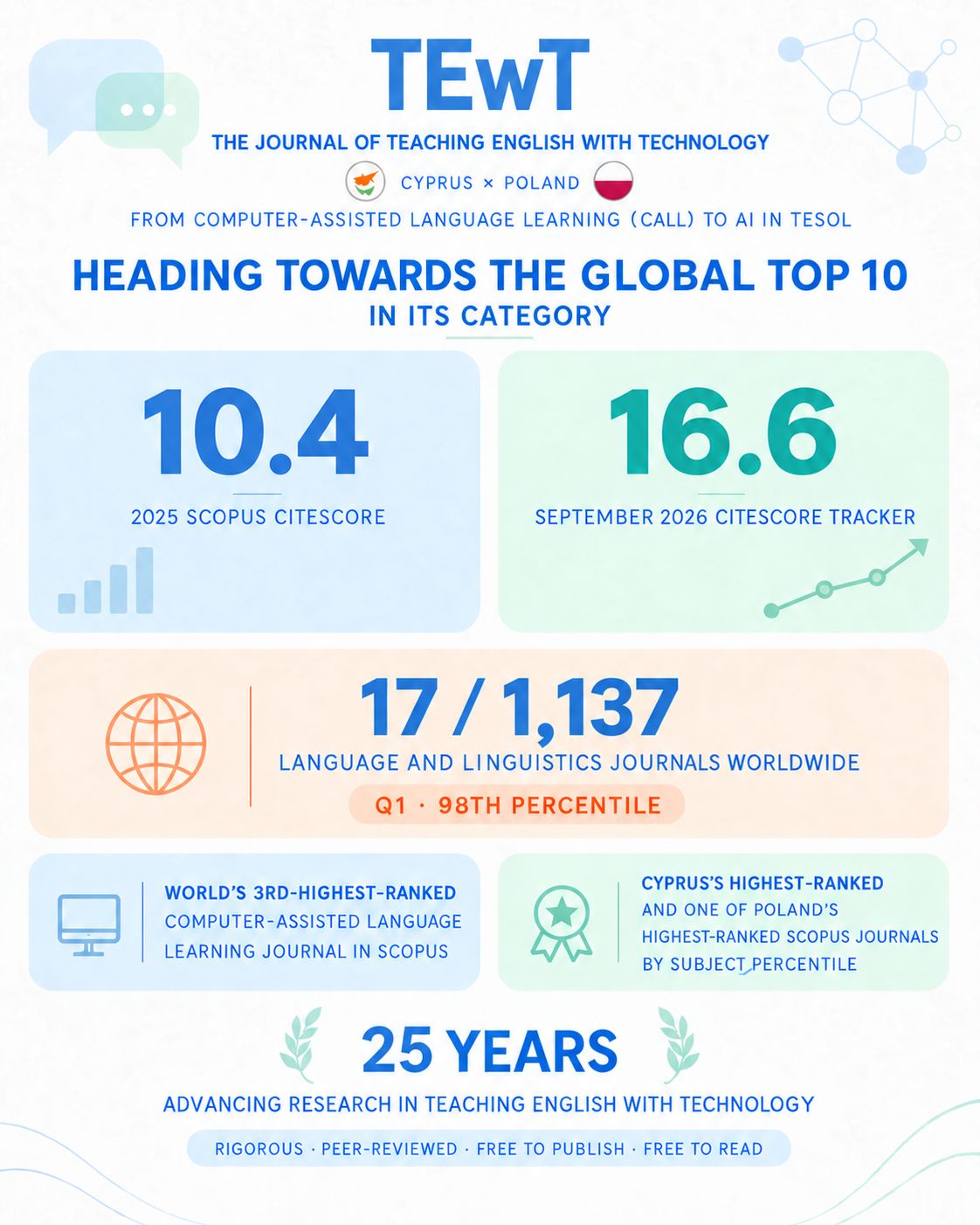
- 2025 Scopus CiteScore: 10.4
- Ranked 17th out of 1,137 Language and Linguistics journals worldwide
- Q1 and in the 98th percentile
- The world’s third-highest-ranked Computer-Assisted Language Learning journal in Scopus
- September 2026 CiteScore Tracker: 16.6
- Cyprus’s highest-ranked Scopus journal—and one of Poland’s highest-ranked—by CiteScore subject percentile
If this trajectory is sustained through Scopus’s final annual calculation, TEwT could enter the global top ten in Language and Linguistics.
These achievements also demonstrate what Cyprus–Poland collaboration can contribute to research, innovation and responsible AI.
Our latest issue brings this mission to life through research on AI-driven and peer feedback, generative AI in EFL writing, AI literacy in English for Academic Purposes, learners’ choices between dictionaries and AI tools, and the responsible use of AI translation.
AI does not reduce the need to learn English.
It raises the level at which English must be taught and used.