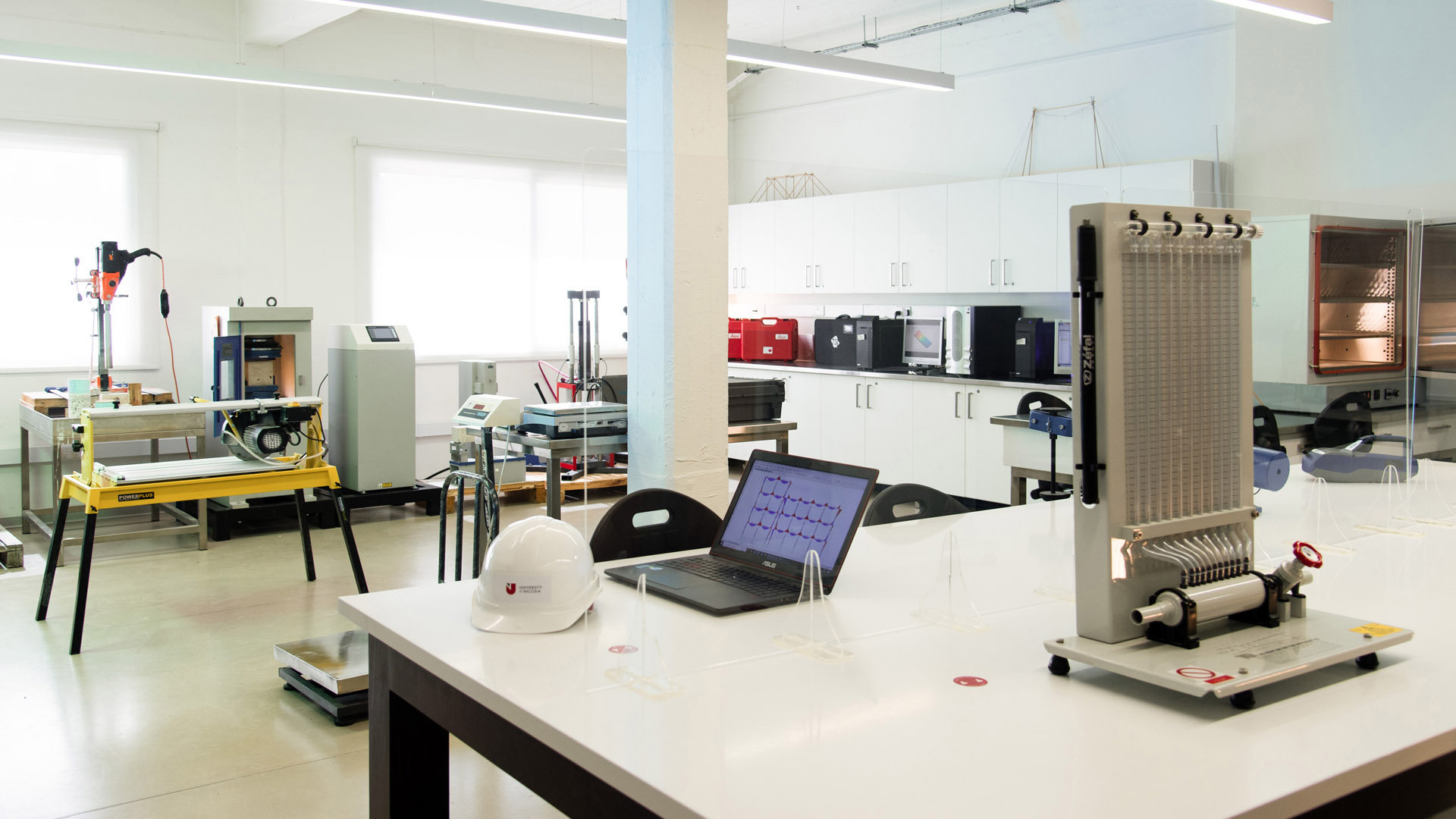
The Thermo-fluids Laboratory hosts a comprehensive collection of bench-top experimental equipment designed to support fundamental understanding and practical exploration of thermodynamics, fluid mechanics, and heat transfer. Core apparatus such as the Boyle’s Law unit and the Marcet boiler enable students to investigate key thermodynamic relationships, including pressure–volume behavior of gases and the temperature–pressure characteristics of saturated steam, reinforcing theoretical models like the Antoine equation. Measurement-focused systems—including the temperature calibration rig, Bourdon pressure gauge unit, and pressure measurement bench—provide hands-on experience in instrument accuracy, calibration techniques, and the comparative performance of pressure and temperature sensing devices widely used in engineering practice.
Fluid dynamics and heat transfer principles are similarly addressed through dedicated experimental setups. The Bernoulli’s theorem apparatus and pipework energy losses rig allow detailed study of flow behavior, head distribution, and frictional losses in pipes and fittings, while the heat transfer base unit and thermal conductivity measurement system support investigation of conduction and broader heat transfer modes. Extending beyond traditional thermo-fluid topics, the laboratory also includes a custom electrocoagulation unit demonstrating redox chemistry applications in wastewater treatment, highlighting the interdisciplinary nature of modern engineering. Together, these systems underpin a strong experimental learning environment, enabling students to bridge theoretical concepts with real-world engineering applications and develop essential laboratory, analytical, and problem-solving skills.
The Thermo-fluids Laboratory consists of two sections, namely:
- Fluid Mechanics
- Thermodynamics
The Fluid Mechanics section includes a controlled recirculating water supply and precise volumetric measurement systems for hydraulic and fluid mechanics experiments. A Bernoulli’s theorem demonstration apparatus allows measurement of the static pressure head distribution along a horizontal Venturi tube. A hydrostatic pressure apparatus supports practical investigations of pressure measurement using manometers and Bourdon gauges. Students also examine head loss in small‑bore pipes and fittings (e.g., straight runs, bends, valves). Collectively, these rigs cover the fundamental theorems and relations used in introductory fluid mechanics instruction, including continuity, Bernoulli, hydrostatics, Pascal’s law, and head‑loss equations.
The Thermodynamics section supports core experiments in thermodynamics and thermal sciences. Students examine gas behavior with a Boyle’s law apparatus, practice temperature measurement and calibration using standard sensors and reference devices, and study steadystate heat transfer in solids. The Marcet boiler enables pressurized boiling experiments to relate saturation temperature to pressure and to compare observations with steam tables. These exercises develop skills in experimental setup, safe handling of hot and pressurized systems, data acquisition, and comparison of results with analytical models.
Below is a list of the experimental apparatusincluded in the laboratory together with a brief description:
- IDEAL GASES – BOYLE’S LAW
Bench top apparatus that demonstrates the relationship between pressure and volume of an ideal gas at a fixed temperature. - TEMPERATURE MEASUREMENT AND CALIBRATION
Studies the accuracy, linearity and important characteristics of popular temperature measuring devices. - SATURATED STEAM – THE MARCET BOILER
An experimental apparatus to derive the temperature pressure relationship for saturated steam, and verify the Antoine Equation. - CALIBRATION OF A BOURDON PRESSURE GAUGE
A Bourdon pressure gauge with visible working mechanism to demonstrate how this type of pressure gauge works and how to calibrate it. - PRESSURE MEASUREMENT BENCH
A bench mounting apparatus to enable practical demonstrations and investigations into pressure and vacuum measurement techniques using manometers and Bourdon type gauges. - BERNOULLI’S THEOREM
A bench top Venturi tube that allows students to study Bernoulli’s theorem by measuring the complete static head distribution along the horizontal tube. - PIPEWORK ENERGY LOSSES
Compact, bench top apparatus compares pressure losses and k value of popular fittings in small bore pipework.
- HEAT TRANSFER EXPERIMENT BASE UNIT
A bench top base unit for demonstrating different methods of heat transfer. - SIMPLE METHOD FOR MEASURING THERMAL CONDUCTIVITY
A custom made base unit for demonstrating method for measuring the thermal conductivity of low thermal conductive materials. - REDOX CHEMISTRY – ELECTROCOAGULATION
A custom made base unit for demonstrating way to treat wastewater using electricity.
Gallery
Facility Details
Type
Engineering Lab
Room
RTA10a
Building
Capacity
16