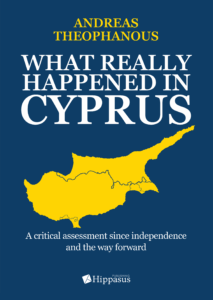
The new book by Professor Andreas Theophanous
WHAT REALLY HAPPENED IN CYPRUS
A critical assessment since independence and the way forward
Hippasus Publications, September 2025 (353 pages)
The new book of Professor Andreas Theophanous entitled “WHAT REALLY HAPPENED IN CYPRUS – A critical assessment since independence and the way forward» consists of a Preface, an Introduction, 8 Chapters, a Bibliography, 2 Indexes of Names and Terms, and also has 15 Appendices.
The author comprehensively assesses developments regarding the Cyprus problem from 1960 to the present day and makes suggestions for the future. Professor Andreas Theophanous examines how the dynamics of the Cyprus problem have evolved and evaluates the policies of all the Presidents of the Republic of Cyprus in relation to it.
The author points out that there are not many countries where the divergence between the best and worst possible outcomes is so great. Evidently, the Cyprus problem is an existential issue. He also considers it essential to have historical self-awareness and a good understanding of the current situation. Theophanous also makes specific policy recommendations; he suggests some fundamental guidelines for the revision of the 1960 constitution as well as CBM’s and other actions involving the two major Cypriot communities, the guarantor countries and other powers. He also adopts an evolutionary approach for addressing the Cyprus problem.
Andreas Theophanous underlines that the long-term ideological framing of the Cyprus problem has been harmful. There was bigotry, intolerance, emotional reactions, populism and a lack of pragmatism, which inevitably led to disastrous results. Even today there are still similar attitudes albeit to a lesser extent. The author also underlines that the insufficient utilization of scientific expertise by various decision-making centers in Cyprus and Greece has led to problematic outcomes. Unfortunately, this is still the case today.
After 1974, there has been no solution to the Cyprus problem because of Turkish maximalism and not because of the “long-term struggle”, which in reality has never been carried out. The Republic of Cyprus and Cypriot Hellenism are facing existential threats. Hence, there is an imperative necessity for a survival strategy that should be based on a concrete narrative. There have been several proposals and plans since 1974, however, the majority of Greek Cypriots believe that their implementation would have worsened the status quo. In addition, Turkey would only accept a plan that would satisfy its major objective – the strategic control of Cyprus.
The author also analyzes the current situation in Cyprus in light of wider geopolitical developments. Within this framework, he assesses the similarities and differences between the cases of Cyprus and Ukraine, as well as the differences in the approaches of the EU, the UN and other powers. The author evaluates the importance of International Law and Realpolitik in International Relations and critically examines the responsibilities of the guarantor countries as well as the role of other actors.
Taking into account all aspects of the current situation, Andreas Theophanous briefly describes the implications of several scenarios for the solution of the Cyprus conflict. He concludes that in today’s circumstances it will be difficult to find a viable solution which improves the status quo. However, if the goal is to restore the unity and territorial integrity of Cyprus, it is necessary to have a comprehensive strategy.
Cyprus should become a model state for the Eastern Mediterranean and the wider region. Such a development will strengthen a network of interests which will have as its center the Republic of Cyprus. Andreas Theophanous emphasizes the need to adopt a new approach to the Cyprus problem based on pragmatism, as well as the correct evaluation of geopolitical dynamics and scientific analysis of the events.
This book fills a gap in the English literature. Beyond the historical and political evaluation, Andreas Theophanous presents specific suggestions for the future. They include, among others, major proposals for the revision of the 1960 constitution in order to create a modern and well-functioning federal state, as well as significant confidence-building measures and other forms of cooperation aimed at overcoming mutual distrust between the two communities. The author’s proposal also highlights the role of the guarantor countries, the EU and of other powers. These should be undertaken through an evolutionary process. Last but not least, the methodology Theophanous adopts allows for the further enrichment of propositions for the future.
The book is available at the Offices of the Cyprus Center for European and International Affairs for €25. It is also available online as a Kindle edition via Amazon for €8.58 at the following link: https://www.amazon.de/dp/B0FX4BPMBR.