

17 June 2025
Exploring Automation with Zapier : A Review
To understand Zapier’s practical limits, we built three proof‑of‑concept automations.

At our team, we continually evaluate tools that can reclaim time, reduce manual work, and free people to focus on higher‑value work. One platform that has earned a place on our shortlist is Zapier, the no‑code integration service that links more than 7,000 cloud applications through configurable workflows—or “Zaps.”
To understand Zapier’s practical limits, we built three proof‑of‑concept automations. Each one combines standard triggers with filters, external APIs, and (in two cases) generative‑AI summarisation. The results have been encouraging and suggest that Zapier can operate as lightweight middleware for many information‑centric tasks.
1. YouTube Auto-Summarizer
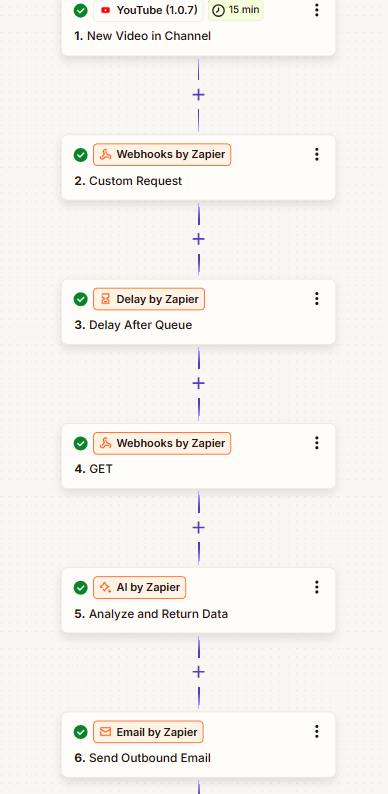
We created a Zap that automatically detects when a new video is uploaded to one of our favorite YouTube channels. The automation pulls the audio, sends it to AssemblyAI for transcription, waits while it processes, then grabs the transcript. That transcript is fed to Zapier’s built-in AI to generate a short summary, which is then emailed to us directly. It’s like having a personal assistant keeping us updated—without lifting a finger.
2. Crypto Price Alerts
This one checks the Bitcoin price every hour via the CoinGecko API. It applies a custom filter—so, for example, if the price drops below or rises above a certain threshold—we immediately get an email notification. It's a straightforward but effective use case for real-time monitoring with conditional triggers.

3. Smart RSS Article Summarizer
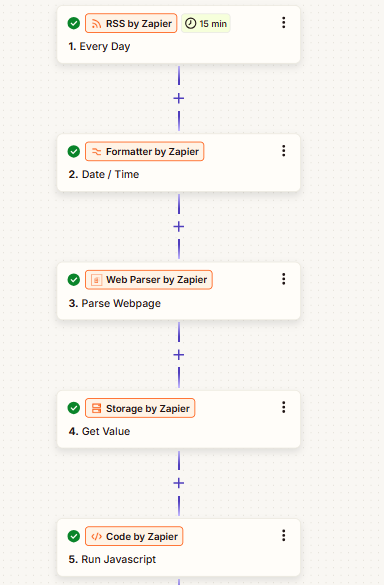
Our most advanced experiment yet. Every 15 minutes, this Zap checks an RSS feed for new articles. It then:
- Parses the page for content
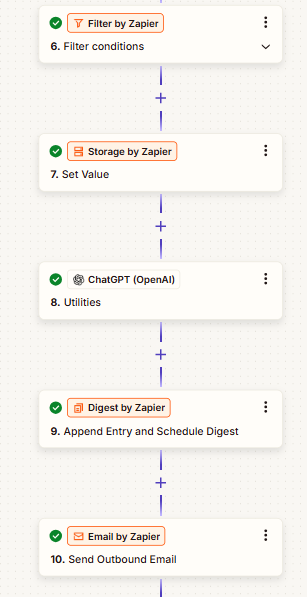
- Checks how many articles have already been processed today (we cap it at 6 using a custom storage logic)
- Uses JavaScript to increment the count
- Summarizes the content via OpenAI's ChatGPT
- And finally, emails us a clean summary
It's a great demonstration of how you can combine state tracking, code, parsing, and AI to build a content curation engine from scratch, without writing a backend.
A Lack of Safety Checks
Another issue the Zapier system has, is in the way it flags an execution as complete. Zapier's tools (e.g. Zapier AI and Zapier YouTube) do not communicate properly - so if the YouTube app can't communicate the video contents to the AI, the AI will not flag it as a failed task and make things up - thereby generating absolutely useless content but still removing a credit from your account. You can imagine how this can easily result in massive loss of time - and money.
The Verdict So Far
These first Zaps have shown us that Zapier is far more than a novelty. It’s a practical, scalable way to automate workflows across tools we use every day—whether for media monitoring, financial tracking, or content digestion. We’re excited to keep exploring what’s possible and push the boundaries of what no-code can do.
Something to be aware of. Watch the task meter closely. Because every step counts as a task—including Filters, Paths, and AI calls—quotas deplete quickly. A five‑step Zap that runs once an hour consumes roughly 3 600 tasks per month, exhausting the 2 000‑task Starter plan in less than three weeks.